
If you were just arrested for a first DUI in Virginia, take a breath. A charge is not a conviction, and a lot about your case is still open. But the process moves quickly, so we’re here to help.
Below, we walk through what happens next, in the order it usually happens, and what Virginia law requires for a first offense. One note on wording: in Virginia, DUI and DWI mean the same thing. Both refer to a charge under Va. Code § 18.2-266, so a “DWI first offense” in VA is the same charge as a first-offense DUI.
Quick general answer to “What happens next?”: A first-offense DUI in Virginia is a Class 1 misdemeanor, not a felony, unless someone was seriously hurt or killed. A conviction carries a mandatory minimum $250 fine, up to 12 months in jail, a one-year loss of your license, and required ASAP classes. Jail is mandatory only if your BAC was 0.15 or higher or a child was in the car. Many first offenders can ask the court for a restricted license and keep driving with an ignition interlock.

Is a DUI a felony in Virginia?
No, not for a typical first offense. A first DUI is a Class 1 misdemeanor under Va. Code § 18.2-270(A). That is the most serious level of misdemeanor in Virginia, with a maximum of 12 months in jail and a $2,500 fine.
A DUI becomes a felony in Virginia in these situations:
- A third DUI within 10 years is a Class 6 felony.
- Any DUI after a prior felony DUI, or after a conviction for DUI maiming or DUI manslaughter, is a Class 6 felony.
- A DUI that causes serious, permanent injury can be charged as DUI maiming, a Class 6 felony, even on a first offense.
- A DUI that causes a death can be charged as involuntary manslaughter, a felony.
So if no one was hurt and this is your first offense, you are facing a misdemeanor. It is still a criminal charge, and it still deserves a real defense.
What happens after a first DUI arrest in Virginia, step by step:
- The arrest and the breath test. After a DUI arrest, Virginia’s implied consent law requires a breath (or sometimes blood) sample. This is not the small roadside device. Unreasonably refusing the post-arrest test is its own charge: a first refusal is a civil offense with a one-year suspension, on top of the DUI case.
- An automatic 7-day license suspension. If the breath test shows 0.08 or higher, or you refuse, the officer serves a notice of suspension and takes your Virginia license on the spot. For a first offense, it lasts seven days. You can ask the General District Court to review it if the arrest lacked probable cause.
- The magistrate and a court date. You will see a magistrate about bond and leave with a date in General District Court. Locally, that usually means the Harrisonburg/Rockingham County General District Court, steps from our office on Court Square.
- The first court date. The purpose of this hearing is to determine whether you will be requesting a court appointed attorney and schedule a trial date. If you have not retained a lawyer prior to this day, you must appear. If you have hired an attorney, in many courts the attorney can appear without you on this date.
- The weeks before trial. This gap of time is where some important decisions get made. Virginia now lets you enroll in ASAP and install an ignition interlock before trial, and that time counts toward any interlock period ordered later. Whether that makes sense for you depends on the evidence, so talk it through with your lawyer first.
- Trial or resolution. The Commonwealth must prove you were operating the vehicle and that you were at 0.08 or above, or under the influence. A DUI charge can end in a dismissal (an acquittal), a reduced charge, or a conviction.
- If you are convicted. Sentencing, the one-year operator’s license revocation, ASAP, and (with a restricted license) the interlock follow. Each is covered below.
- Getting your full license back. After the revocation period, you finish ASAP, meet any court and DMV conditions, and pay a $105 reinstatement fee.
Potential First-Offense DUI Penalties in Virginia
For a first offense, the only automatic penalties are the $250 minimum fine, the one-year license revocation, and ASAP. Jail is mandatory only in certain situations, included in those listed below.
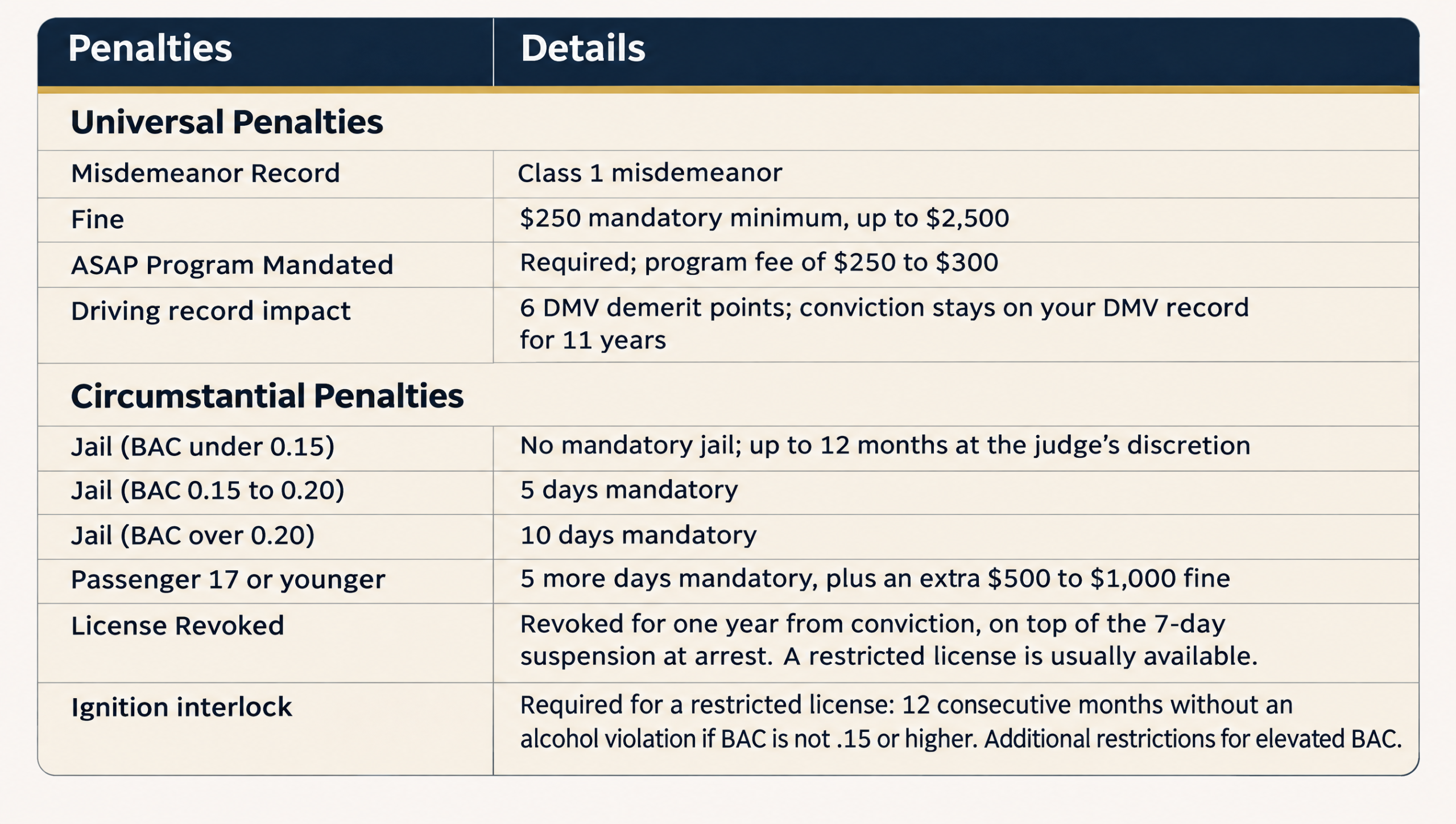
Mandatory minimums stack. A driver at 0.21 with a 10-year-old in the back seat faces at least 15 days in jail and at least $750 in fines, even on a first offense.
Your license after a first DUI: suspension, revocation, and the restricted license
Three different license consequences can apply, and people often mix them up.
- The 7-day administrative suspension starts at arrest, before any trial.
- The one-year revocation comes only with a conviction. It runs from the date of judgment, but the clock does not start until you surrender your license to the court or DMV.
- The restricted license lets you drive during that year if the court grants it. For an adult with a first offense and a BAC below .15, the only restriction the court imposes is the ignition interlock, so you can drive for any lawful purpose. It cannot start during the first seven days of the suspension, depends on enrolling in ASAP within 15 days, and never covers a commercial vehicle.
How ignition interlock works for a first offense
An ignition interlock is a breath tester wired to your ignition. The car will not start if it reads above 0.02, and it asks for random retests while you drive.
- How long it’s required: 6 or 12 consecutive months without an alcohol-related violation, depending on the restricted license granted by the Court.
- When the clock starts: on the day the court issues your restricted license, or earlier if you installed the device before trial.
- What it costs: you pay to lease, install, and monitor the device, plus a $20 court fee. You must show ASAP proof of installation within 30 days and have it calibrated at least every 30 days.
- What not to do: having someone else blow into it, or tampering with it, is a Class 1 misdemeanor.

ASAP: a program required for almost every first offender
ASAP is the Virginia Alcohol Safety Action Program. If you are convicted of a first DUI, the court must order you to enter and complete it. The only exception is when ASAP assesses you, finds intervention is not appropriate, and the judge agrees.
The program fee is $250 to $300, which the court can reduce or waive if you cannot afford it. Any treatment ASAP refers you to can cost more. ASAP also supervises your interlock and restricted license, so falling behind there can cost you the right to drive.
Where the outcome can still be an open question:
The penalties above apply only after a conviction, and a conviction is never automatic. These are the questions a defense attorney looks at first:
- Was the stop lawful? An officer needs a legal reason to pull you over. If the stop was not justified, the evidence that followed can be challenged.
- Was there probable cause to arrest? Field sobriety tests are voluntary and subjective.
- Was the breath test done properly? The law sets rules for how the test is given and certified. The roadside preliminary breath test cannot be used at trial to prove guilt.
- Which side of 0.15 is the result? A 0.14 and a 0.15 are a single point apart, but one carries no mandatory jail, and the other carries five days.
- How should you handle your license before trial? Pre-trial ASAP and an interlock can shorten your time on the device later, but it is a strategic choice.
Cook’s Take: Do not assume the breath number decides your case. First-offense cases often turn on the stop, the paperwork, and the timeline. Bring us your summons and your suspension notice, and we will tell you plainly where your case is strong and where it is not.
How long a first DUI stays with you
- Criminal record: a DUI conviction stays on your Virginia criminal record permanently. Expungement covers charges that end without a conviction, not convictions.
- Future charges: a first conviction counts as a prior for 10 years. A second DUI inside that window brings mandatory jail and a three-year revocation.
- Insurance: expect higher premiums and possibly extra proof-of-insurance filings before full reinstatement.
What to do this week
- Write down everything you remember about the stop while it is fresh.
- Keep your summons, suspension notice, and any bond paperwork together.
- Do not drive during the 7-day suspension. Driving on a suspended license is a separate charge.
- Hold off on ASAP or an interlock until you have talked to a lawyer about timing.
- Stay off social media about the arrest.
- Call a defense attorney before your first court date.
How Cook Attorneys can help
Our office sits at 71 Court Square in Harrisonburg, next to the Rockingham County courthouses where most DUI cases in the Valley are heard. Our team includes two former prosecutors, and we take a limited number of clients so each case gets real attention.
If you are facing a first-time DUI, schedule a free, no-pressure consultation or call (540) 564-9699. Learn more about our traffic defense and criminal defense work. For related reading, see DUI in Virginia: what to do after an arrest and Virginia’s legal alcohol limit.
Frequently asked questions
Is a first DUI a felony in Virginia?
No. A first-offense DUI in Virginia is a Class 1 misdemeanor. It can be charged as a felony only if the crash caused serious, permanent injury (DUI maiming) or a death (involuntary manslaughter).
Will I go to jail for a first DUI in Virginia?
Not necessarily. Jail is mandatory only if your BAC was 0.15 to 0.20 (5 days), over 0.20 (10 days), or a passenger was 17 or younger (5 more days). Otherwise, any jail time is up to the judge, to a maximum of 12 months.
How long do you lose your license for a first DUI in Virginia?
Seven days right after the arrest, then one year if you are convicted. Many first offenders can get a restricted license with an ignition interlock and keep driving, to work or anywhere else lawful, during that year.
Is DWI the same as DUI in Virginia?
Yes. Virginia uses both terms for the same offense under Va. Code § 18.2-266. Court papers often say DWI.
Can a first DUI be expunged in Virginia?
Only if the charge ends without a conviction, such as a dismissal or acquittal. A DUI conviction stays on your criminal record permanently. Virginia’s new sealing law does not permit the sealing of DUIs.
What if I refused the breath test?
A first refusal is a separate civil offense with its own one-year suspension, and the refusal can be used as evidence in your DUI trial.
This article is general information about Virginia law as of November 2026, not legal advice. Every case is different, and the law can change. Reading this post does not create an attorney-client relationship with Cook Attorneys. For advice about your situation, speak with a licensed attorney.