What Happens For You And Your Record After Dismissed Charges?

what is a dismissed case

“Case dismissed!” We’ve all seen the dramatic scenes in TV and movies, where a judge bangs his gavel and waves everyone out of his courtroom. But what does that mean for you?
If the case against you is dismissed, do you have a criminal record? Can you still be charged with the same crime?
Navigating dismissed cases can be confusing, but we’re here to help.


WHAT IS A DISMISSED CASE?

A dismissed criminal case is one in which you were not convicted.  When a criminal charge is dismissed, you are not guilty and the case is concluded.


ARE THERE DIFFERENT KINDS OF DISMISSED CASES?

The short answer is Yes, and the difference arises out of whether jeopardy has attached.

The fifth amendment of the United States Constitution guarantees that no person will “be subject for the same offence to be twice put in jeopardy of life or limb.”  This is known as the Double Jeopardy Clause and it means that, once acquitted, no one can thereafter be tried again for the same offense.

Under Virginia law, jeopardy attaches after the jury has been sworn to begin a trial and, if it is a trial without a jury, jeopardy attaches when the first witness is sworn.  After that moment, with a couple exceptions,  any dismissal including a verdict of not guilty forever ends the prosecution of that defendant for that offense.

But what about a dismissal of the case before the trial?

Most commonly in Virginia, a dismissal before the trial is accomplished my a motion of nolle prosequi made by the prosecutor.  Such a motion is a declaration by the prosecutor that “we will not further prosecute this case” and, if the prosecutor can show there is a good reason for the motion, the Court will grant the motion to nolle prosse, dismissing the charge and concluding the case.  However, because jeopardy has not attached, the charge could be brought back at a later time without violating the Double Jeopardy Clause.

Sometimes, if the Court does not find good cause for a motion of nolle prosequi or if the prosecutor agrees, a criminal case can be dismissed with prejudice, meaning the case is closed and cannot be reprosecuted.

WHAT HAPPENS WHEN A CASE IS DISMISSED IN COURT?

case dismissed in court

If your case is dismissed, talk with your lawyer to determine next steps. In some instances, you can move forward with getting the charges expunged from your criminal record.  Your local Harrisonburg lawyers can help you with that. Please contact us at the bottom of this page; we’re here for you.


HOW DO I KNOW IF MY CASE WAS DISMISSED?

Your lawyer will inform you of the status of your case. If it is an old case, or if you need confirmation of your case’s status, you can look it up in the public records. Virginia’s Case Status and Information can be found here.


DOES A DISMISSED CASE SHOW UP ON A BACKGROUND CHECK?

background check

Some background checks only find prior conviction, but many commercial background checks will also find charges placed and dismissed.  In some cases, you can get dismissed cases off of your record by applying in the Circuit Court for an expungement.  You can learn more about expungements in Virginia here or you can contact us at Cook Attorneys.

CAN YOU HELP ME FIGURE OUT WHAT TO DO NEXT?

Yes, Cook Attorneys is here for all of your legal questions and next steps. Contact us through the form below, email info@cookattorneys.com, or call us at 540-564-9699 today.

Fill out the form below to request more information about how we can serve you. We look forward to hearing from you!

What to Do if You’re Questioned by the Police?

do you have to answer police questions

Many of us were raised to believe that the police officer is a friend—like Andy Griffith in Mayberry. But increasingly we find that, unfortunately, police officers seeking to question a potential suspect about an incident are not to be trusted. They will likely not tell a potential suspect the truth on important points nor will they have their best interest at heart.

In this blog article from our team of local criminal attorneys in Harrisonburg, Virginia,will make some general observations and recommendations about responding to questioning by the police. However, this blog article cannot substitute for actual legal advice in a particular situation. We will make some statements in this article that are generally true but not always true, and we will err on the side of caution and exercising your right to remain silent.


DO YOU HAVE TO ANSWER POLICE QUESTIONS?

No. You never have to answer police questions about where you are going or coming from, what you’re doing, or what you have done, and it is almost always unwise to do so without first consulting a lawyer.  

Know your rights if you’re stopped by the police. In the United States, if you are questioned by the police, you are entitled to exercise your Fifth Amendment right to remain silent, and your Sixth Amendment right to counsel. 

As a general rule, if you have been detained, you must truthfully identify yourself, and beyond that, the only appropriate answer to a police question is: “I want my lawyer.” If you wish to exercise your right to remain silent, state this out loud to the officer and then—remain silent!

If an officer has a reasonable suspicion that criminal activity is afoot, you will need to provide your name to an officer if you’re asked to do so. While they can ask you additional questions and will make it seem like you are required to answer, you are not required to answer and in most cases you should not.

 Remember: if you wish to exercise your right to remain silent, state this out loud to the officer. And state it unequivocally.

If you’re questioned by the police in Harrisonburg or Rockingham County, we strongly encourage you to contact our lawyers to get professional advice on your options.


DO POLICE HAVE TO IDENTIFY THEMSELVES WHEN QUESTIONING SOMEONE?

Typically, law enforcement officers on routine patrol wear official agency-issued uniforms with a name badge and the law enforcement agency clearly displayed. Occasionally, though, police officers, and particularly police investigators, will wear ‘plainclothes’ such as business or business casual dress, usually with a badge clearly displayed on the belt or hanging around the neck.  And, of course, police officers working ‘undercover’ wear regular clothes and do not identify themselves. Despite a persistent myth our clients often believe, an undercover officer is permitted to lie to you if you ask if they are a cop. 

Many people think that police officers are always required to identify themselves, and certainly if they attempt to exercise police authority in a situation they must first identify themselves as police officers. But police officers are usually allowed, for example, to strike up what appears to be a casual conversation without identifying themselves as a law enforcement officer. 

When you encounter a police officer either during a detention or during questioning, make a note of their name. If it is not clearly displayed, ask for it; in most situations they are required to provide it.


INFORMAL SCENARIOS OF POLICE QUESTIONING

When investigating a complaint that a crime has been committed, police officers and investigators gather information, primarily through questioning any witness who might have information about what happened. They should attempt to question everyone present during an incident, and even those nearby who may have heard or seen something that will help add to the story of what happened.

The police investigating any crime should also attempt to interview any suspects identified by the witnesses, and—unless they are placing a suspect under arrest—the Miranda warnings are not required. A suspect’s statement will be used against them.  

After compiling all the information they can gather, the police officers should write a report detailing what each person interviewed said in response to the officer’s questions. It is also important to realize that recent technological advances such as body-worn cameras make it very easy for most law enforcement agencies to record statements from any person an officer questions.

There are many scenarios of police questioning. Some are formal, such as in a police station after an arrest, while others are informal—so informal, that you may not realize you’re being officially questioned. Here are a few common examples of police questioning:

  • DURING A TRAFFIC STOP
    If, while operating a vehicle, a police officer orders you to pull over for a traffic infraction, the officer may suspect that other criminal activity is present, such as driving under the influence (DUI), the transportation of illegal drugs, or other illegal activities. The officer will ask questions in an attempt to discover additional evidence, and the answers you give during a traffic stop may lead to more charges.
  • THROUGH A TELEPHONE CALL
    Police investigators prefer face-to-face interviews for many reasons, but we find that officers regularly interview witnesses and even suspects by telephone. Perhaps the telephone seems less-threatening to suspects, but an officer stating that they “just want to get your side of the story” often leads to a partial, or even a complete, confession. You should treat a telephone call from a police officer like any other police questioning, and, as a general rule, politely decline to speak to the officer and immediately schedule an appointment with a local defense attorney.
  • THROUGH A VISIT TO YOUR HOME (AKA, “KNOCK AND TALK”)
    An unexpected visit from a police officer at your home or workplace can feel particularly difficult to refuse, which is why law enforcement officers use this strategy to gather information. People often feel like they need to speak with the officer and succumb to the pressure to answer the officer’s questions, even though they know they should not.  Politely decline to answer any questions and consult with a local criminal attorney for professional legal guidance. Keep in mind that the police officer, if they were being investigated, would do the same.


FORMAL POLICE INTERROGATIONS

if the police call you in for questioning

Police officers are trained to interrogate suspects and their goal is to pressure the suspect by creating an atmosphere where they can find and exploit a psychological weakness. Their aim is to extract a confession, an incriminating statement, or even a partial admission of some fact necessary to prove guilt. Officers might try to establish rapport with the suspect or they might try to exert pressure on a suspect with threats of arrest or calling social services. Never agree to speak in such an interrogation without first consulting a lawyer, and if you decide to submit to such questioning, take your lawyer with you.


Remember: You do not need to submit to a police interview or interrogation on their terms. Instead, contact an attorney who can help you.

know your rights when the police question you


WHAT TO DO IF YOU ARE ARRESTED OR DETAINED?

Stay calm. Don’t run, resist, or obstruct the officers. Do not lie or give false documents. Keep your hands where the police can see them. Say you wish to remain silent and ask for a lawyer immediately. Don’t give any explanations or excuses. Don’t say anything, sign anything, or make any decisions without a lawyer.
If you are allowed a telephone call, remember that the officers standing by are listening and can use even overheard statements against you, and if you are using a phone provided to you, the call is being recorded. Make a phone call only to make arrangements for bond or other logistics. Never discuss the case or the investigation.


OUR ATTORNEYS IN HARRISONBURG, VA CAN HELP YOU

If the police are seeking to question you, then you need the advice of a lawyer. Our team of lawyers in Harrisonburg, VA at Cook Attorneys can help you to achieve the best possible outcome for your situation. 

Fill out the form below to request more information about how we can serve you. We look forward to hearing from you!


What to Do if You’re Questioned by the Police?

do you have to answer police questions

Many of us were raised to believe that the police officer is a friend—like Andy Griffith in Mayberry. But increasingly we find that, unfortunately, police officers seeking to question a potential suspect about an incident are not to be trusted. They will likely not tell a potential suspect the truth on important points nor will they have their best interest at heart.

In this blog article from our team of local criminal attorneys in Harrisonburg, Virginia,will make some general observations and recommendations about responding to questioning by the police. However, this blog article cannot substitute for actual legal advice in a particular situation. We will make some statements in this article that are generally true but not always true, and we will err on the side of caution and exercising your right to remain silent.


DO YOU HAVE TO ANSWER POLICE QUESTIONS?

No. You never have to answer police questions about where you are going or coming from, what you’re doing, or what you have done, and it is almost always unwise to do so without first consulting a lawyer.  

Know your rights if you’re stopped by the police. In the United States, if you are questioned by the police, you are entitled to exercise your Fifth Amendment right to remain silent, and your Sixth Amendment right to counsel. 

As a general rule, if you have been detained, you must truthfully identify yourself, and beyond that, the only appropriate answer to a police question is: “I want my lawyer.” If you wish to exercise your right to remain silent, state this out loud to the officer and then—remain silent!

If an officer has a reasonable suspicion that criminal activity is afoot, you will need to provide your name to an officer if you’re asked to do so. While they can ask you additional questions and will make it seem like you are required to answer, you are not required to answer and in most cases you should not.

 Remember: if you wish to exercise your right to remain silent, state this out loud to the officer. And state it unequivocally.

If you’re questioned by the police in Harrisonburg or Rockingham County, we strongly encourage you to contact our lawyers to get professional advice on your options.


DO POLICE HAVE TO IDENTIFY THEMSELVES WHEN QUESTIONING SOMEONE?

Typically, law enforcement officers on routine patrol wear official agency-issued uniforms with a name badge and the law enforcement agency clearly displayed. Occasionally, though, police officers, and particularly police investigators, will wear ‘plainclothes’ such as business or business casual dress, usually with a badge clearly displayed on the belt or hanging around the neck.  And, of course, police officers working ‘undercover’ wear regular clothes and do not identify themselves. Despite a persistent myth our clients often believe, an undercover officer is permitted to lie to you if you ask if they are a cop. 

Many people think that police officers are always required to identify themselves, and certainly if they attempt to exercise police authority in a situation they must first identify themselves as police officers. But police officers are usually allowed, for example, to strike up what appears to be a casual conversation without identifying themselves as a law enforcement officer. 

When you encounter a police officer either during a detention or during questioning, make a note of their name. If it is not clearly displayed, ask for it; in most situations they are required to provide it.


INFORMAL SCENARIOS OF POLICE QUESTIONING

When investigating a complaint that a crime has been committed, police officers and investigators gather information, primarily through questioning any witness who might have information about what happened. They should attempt to question everyone present during an incident, and even those nearby who may have heard or seen something that will help add to the story of what happened.

The police investigating any crime should also attempt to interview any suspects identified by the witnesses, and—unless they are placing a suspect under arrest—the Miranda warnings are not required. A suspect’s statement will be used against them.  

After compiling all the information they can gather, the police officers should write a report detailing what each person interviewed said in response to the officer’s questions. It is also important to realize that recent technological advances such as body-worn cameras make it very easy for most law enforcement agencies to record statements from any person an officer questions.

There are many scenarios of police questioning. Some are formal, such as in a police station after an arrest, while others are informal—so informal, that you may not realize you’re being officially questioned. Here are a few common examples of police questioning:

  • DURING A TRAFFIC STOP
    If, while operating a vehicle, a police officer orders you to pull over for a traffic infraction, the officer may suspect that other criminal activity is present, such as driving under the influence (DUI), the transportation of illegal drugs, or other illegal activities. The officer will ask questions in an attempt to discover additional evidence, and the answers you give during a traffic stop may lead to more charges.  
  • THROUGH A TELEPHONE CALL
    Police investigators prefer face-to-face interviews for many reasons, but we find that officers regularly interview witnesses and even suspects by telephone. Perhaps the telephone seems less-threatening to suspects, but an officer stating that they “just want to get your side of the story” often leads to a partial, or even a complete, confession. You should treat a telephone call from a police officer like any other police questioning, and, as a general rule, politely decline to speak to the officer and immediately schedule an appointment with a local defense attorney.
     
  • THROUGH A VISIT TO YOUR HOME (AKA, “KNOCK AND TALK”)
    An unexpected visit from a police officer at your home or workplace can feel particularly difficult to refuse, which is why law enforcement officers use this strategy to gather information. People often feel like they need to speak with the officer and succumb to the pressure to answer the officer’s questions, even though they know they should not.  Politely decline to answer any questions and consult with a local criminal attorney for professional legal guidance. Keep in mind that the police officer, if they were being investigated, would do the same.


FORMAL POLICE INTERROGATIONS

if the police call you in for questioning

Police officers are trained to interrogate suspects and their goal is to pressure the suspect by creating an atmosphere where they can find and exploit a psychological weakness. Their aim is to extract a confession, an incriminating statement, or even a partial admission of some fact necessary to prove guilt. Officers might try to establish rapport with the suspect or they might try to exert pressure on a suspect with threats of arrest or calling social services. Never agree to speak in such an interrogation without first consulting a lawyer, and if you decide to submit to such questioning, take your lawyer with you.


Remember: You do not need to submit to a police interview or interrogation on their terms. Instead, contact an attorney who can help you.

know your rights when the police question you


WHAT TO DO IF YOU ARE ARRESTED OR DETAINED?

Stay calm. Don’t run, resist, or obstruct the officers. Do not lie or give false documents. Keep your hands where the police can see them. Say you wish to remain silent and ask for a lawyer immediately. Don’t give any explanations or excuses. Don’t say anything, sign anything, or make any decisions without a lawyer.
If you are allowed a telephone call, remember that the officers standing by are listening and can use even overheard statements against you, and if you are using a phone provided to you, the call is being recorded. Make a phone call only to make arrangements for bond or other logistics. Never discuss the case or the investigation.


OUR ATTORNEYS IN HARRISONBURG, VA CAN HELP YOU

If the police are seeking to question you, then you need the advice of a lawyer. Our team of lawyers in Harrisonburg, VA at Cook Attorneys can help you to achieve the best possible outcome for your situation. 

Fill out the form below to request more information about how we can serve you. We look forward to hearing from you!

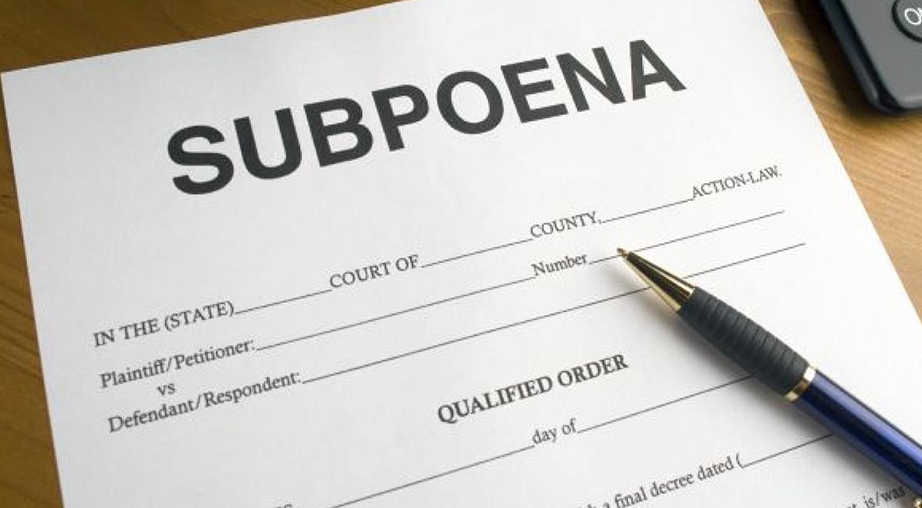
What Happens If You Are Subpoenaed?

questions about subpoena

As part of our ongoing blog series, this article from our lawyers in Harrisonburg, VA will answer the questions “What is a subpoena?,” “How is a subpoena different from a summons?,” “What happens if I’m subpoenaed and I don’t show up to court?” and more.


WHAT IS A SUBPOENA? 

A subpoena [pronunciation] is a court-ordered command that requires someone to either appear in court as a witness, attend a deposition, or provide evidence such as documents or a physical object in a legal case. A witness subpoena requires a witness to appear at the courthouse at a particular time; however, the subpoena itself does not compel the witness to testify or to say anything.


WHO CAN ISSUE A SUBPOENA?

Subpoenas are requested or issued by an attorney or by a party to a legal case, either civil or criminal. Subpoenas can be issued by the court clerk or attorney involved in the legal action. Once issued, a subpoena must be served on the person for whom it’s intended.


HOW IS A SUBPOENA SERVED?

A subpoena is typically served by a sheriff’s deputy on someone in the following ways:

  • Personal delivery (AKA, hand-delivered)
  • Posted delivery on the door at the person’s residence
  • Delivery to a responsible person at the person’s residence or place of employment

subpoena to appear in court


TYPES OF SUBPOENAS

There are two types of subpoenas:

  • Subpoena Ad Testificandum (Witness subpoena)
    Requires someone to appear in person to testify as a witness in a court proceeding or a deposition.
  • Subpoena Duces Tecum
    Commands someone to produce physical evidence such as documents, materials, or other tangible evidence. The subpoena gives a deadline for the production of the physical evidence and will specify where the evidence must be produced. In a criminal proceeding in Virginia, the document or other physician evidence must be produced by delivering it to the Clerk of Court where the proceeding is being held.


EXAMPLES OF REASONS FOR A SUBPOENA

Subpoenas enable attorneys to obtain evidence, including testimony, that will help them present a client’s case.

For example, our local criminal attorneys at Cook Attorneys in Harrisonburg, Virginia often issue subpoenas to witnesses to testify in court regarding the facts surrounding an event that led to a client’s arrest.

Examples of subpoenas duces tecum we have requested include:

  • Income tax returns
  • Contracts
  • Cell phones
  • Bookkeeping records
  • Insurance records
  • Employee records
  • Lease agreements

In a criminal case, we cannot subpoena information from the prosecutor or the police department investigating the case. Production of those materials is subject to the rules of discovery. A subpoena duces tecum can be used, however, to obtain evidence in the possession of a third party to the case, including a government agency not involved in the prosecution of the case.

hire a Harrisonburg attorney if you’re subpoenaed


HOW IS A SUBPOENA DIFFERENT FROM A COURT SUMMONS?

A summons is an official notice to appear in court which is provided to a party to the case, not a witness. In a civil case, the summons is the notice of the lawsuit which is given to the person who is being sued. This gives the defendant the opportunity to appear in court and contest the claim. In a criminal case, an accused person can be released after the issuance of a summons given in lieu of an arrest by a warrant which requires the person be taken into custody. A speeding ticket is, formally, such a summons.


ARE THERE PENALTIES FOR IGNORING A SUBPOENA?

You do not have the right to ignore a subpoena. The Latin word ‘subpoena’ translates to ‘under penalty’ which means that if you are served a subpoena and don’t comply with the order, you will face a penalty. If you fail to follow the orders of a subpoena, you will be considered ‘in contempt of court’ and face civil or criminal penalties including jail time, fines, or both.


WHAT SHOULD I DO IF I RECEIVE A SUBPOENA?

If you are served a subpoena, begin by fully reading through the subpoena to make sure you understand what is required of you. Do you need to appear in court to serve as a witness? Do you need to provide materials? Subpoena requests should be very specific.

Immediately make note of the court date or filing deadline on your calendar. If your subpoena states that you must appear in court, make sure you clear your schedule for that date. In most cases, if you’ve been requested to appear in person, you will not be able to decline.

In most situations, it is appropriate to contact the attorney who requested or issued the subpoena. Ideally, he has already spoken with you and you knew the subpoena was coming, but if he hasn’t, give him a call to make sure you understand what is expected of you.

Sometimes, though, the subpoena may be hostile to your interests. In that case, consult with a respected attorney, such as those on our team of Harrisonburg lawyers, to guide you through the situation to ensure you’re properly prepared to face your subpoena. There may also be an opportunity to quash (or contest) the subpoena, or there may be grounds to assert your Fifth Amendment privilege against self-incrimination.


WE CAN SUPPORT YOU IF YOU’VE BEEN SUBPOENAED

Our Harrisonburg attorneys will provide you with the guidance you need to follow the proper procedures to fully comply with a subpoena’s demands. We can also help to prepare you if you are required to go to court as a witness in a criminal matter.
Fill out the form below to request more information about how we can serve you. We look forward to supporting you.


What Happens If You Are Subpoenaed?

questions about subpoenaAs part of our ongoing blog series, this article from our lawyers in Harrisonburg, VA will answer the questions “what is a subpoena?,” “how is a subpoena different from a summons?,” “what happens if I’m subpoenaed and I don’t show up to court?,” and more.


WHAT IS A SUBPOENA?

A subpoena [pronunciation] is a court-ordered command which requires someone to either appear in court as a witness, attend a deposition, or provide evidence such as documents or a physical object in a legal case. A witness subpoena requires a witness to appear at the courthouse at a particular time; however, the subpoena itself does not compel the witness to testify or to say anything.


WHO CAN ISSUE A SUBPOENA?

Subpoenas are requested or issued by an attorney or by a party to a legal case, either civil or criminal. Subpoenas can be issued by the court clerk or by an attorney involved in the legal action. Once issued, a subpoena must be served on the person for who it’s intended.


HOW IS A SUBPOENA SERVED?

A subpoena is typically served by a sheriff’s deputy on someone in the following ways:

  • Personal delivery (AKA, hand-delivered)
  • Posted delivery on the door at the person’s residence
  • Delivery to a responsible person at the person’s residence or place of employment

subpoena to appear in court


TYPES OF SUBPOENAS

There are two types of subpoenas:

  • Subpoena Ad Testificandum (Witness subpoena)
    Requires someone to appear in person to testify as a witness in a court proceeding or a deposition.
  • Subpoena Duces Tecum
    Commands someone to produce physical evidence such as documents, materials, or other tangible evidence. The subpoena gives a deadline for the production of the physical evidence and will specify where the evidence must be produced. In a criminal proceeding in Virginia, the document or other physician evidence must be produced by delivering it to the Clerk of Court where the proceeding is being held.


EXAMPLES OF REASONS FOR A SUBPOENA

Subpoenas enable attorneys to obtain evidence, including testimony, that will help them present a client’s case.

For example, our local criminal attorneys at Cook Attorneys in Harrisonburg, Virginia often issue subpoenas to witnesses to testify in court regarding the facts surrounding an event that led to a client’s arrest.

Examples of subpoenas duces tecum we have requested include:

  • Income tax returns
  • Contracts
  • Cell phones
  • Bookkeeping records
  • Insurance records
  • Employee records
  • Lease agreements

In a criminal case, we cannot subpoena information from the prosecutor or from the police department investigating the case. Production of those materials are subject to the rules of discovery. A subpoena duces tecum can be used, however, to obtain evidence in the possession of a third party to the case, including a government agency not involved in the prosecution of the case.

hire a Harrisonburg attorney if you’re subpoenaed


HOW IS A SUBPOENA DIFFERENT FROM A COURT SUMMONS?

A summons is an official notice to appear in court which is provided to a party to the case, not a witness. In a civil case, the summons is the notice of the lawsuit which is given to the person who is being sued. This gives the defendant the opportunity to appear in court and contest the claim. In a criminal case, an accused person can be released after the issuance of a summons given in lieu of an arrest by a warrant which requires the person be taken into custody. A speeding ticket is, formally, such a summons.


ARE THERE PENALTIES FOR IGNORING A SUBPOENA?

You do not have the right to ignore a subpoena. The Latin word ‘subpoena’ translates to ‘under penalty’ which means that if you are served a subpoena and don’t comply with the order, you will face a penalty. If you fail to follow the orders of a subpoena, you will be considered ‘in contempt of court’ and face civil or criminal penalties including jail time, fines, or both.


WHAT SHOULD I DO IF I RECEIVE A SUBPOENA?

If you are served a subpoena, begin by fully reading through the subpoena to make sure you understand what is required of you. Do you need to appear in court to serve as a witness? Do you need to provide materials? Subpoena requests should be very specific.

Immediately make note of the court date or filing deadline on your calendar. If your subpoena states that you must appear in court, make sure you clear your schedule for that date. In most cases, if you’ve been requested to appear in person, you will not be able to decline.

In most situations it is appropriate to contact the attorney who requested or issued the subpoena. Ideally, he has already spoken with you and you knew the subpoena was coming, but if he hasn’t, give him a call to make sure you understand what is expected of you.

Sometimes, though, the subpoena may be hostile to your interests. In that case, consult with a respected attorney, such as those on our team of Harrisonburg lawyers, to guide you through the situation to ensure you’re properly prepared to face your subpoena. There may also be an opportunity to quash (or contest) the subpoena, or there may be grounds to assert your Fifth Amendment privilege against self-incrimination.


WE CAN SUPPORT YOU IF YOU’VE BEEN SUBPOENAED

Our Harrisonburg attorneys will provide you with the guidance you need to follow the proper procedures to fully comply with a subpoena’s demands. We can also help to prepare you if you are required to go to court as a witness in a criminal matter.
Fill out the form below to request more information about how we can serve you. We look forward to supporting you.


Benefits of Working with Cook Attorneys’ Bi-Lingual Legal Team

immigration lawyers speak Spanish in Harrisonburg


If English is not your native language, you definitely won’t need to feel intimidated by the US legal system if you have our team at Cook Attorneys on your side. 

Whether you need a criminal defense attorney, lawyers that handle traffic tickets, an attorney for a college student who’s been arrested or an immigration lawyer in Harrisonburg VA, we are here to support you and your family through our internal bi-lingual English/Spanish speaking team and our connections to interpreters and translators specializing in additional languages. 


OUR SPANISH-SPEAKING LEGAL TEAM 


Our legal assistant at Cook Attorneys natively speaks Spanish and attorney Scott T. Hansen speaks Spanish as a second language. 

As a Spanish speaking lawyer, Scott regularly represents our Hispanic clients and advises immigrants on matters of immigration law. During college, Scott spent time in Honduras where he resided with an exclusively Spanish speaking family. Throughout his nearly twenty years of legal practice, he’s continued to learn, practice and expand his Spanish on an almost daily basis through serving Cook Attorneys’ Spanish speaking clients and their families.


Here are just a few of the many testimonials our clients have given about their work with Scott:

“Wonderful lawyers who actually care about clients. If you’re in need of an immigration lawyer, give Scott Hansen a call.” – Sofi Shaffer

“Would definitely recommend Scott Hansen if you are in need of a lawyer. He will put in his time and work for the best possible outcome for you.” – Aaron Argenbright

“If you need an attorney I highly recommend Scott Hansen. Extremely knowledgeable and professional. If you need a criminal defense attorney you will not find a better one in Harrisonburg!” – Nikki Bridges


spanish speaking immigration and criminal attorneys


WHAT IS THE DIFFERENCE BETWEEN INTERPRETATION AND TRANSLATION?


An interpreter is a person who orally translates spoken words from one language to another, on the spot, in real-time. A translator interprets written text. An oral interpreter may be able to work as a translator for written materials, however, a translator does not necessarily have spoken language skills or an understanding of cultural nuances to work successfully as an interpreter. 


INTERPRETATION


When someone provides interpretation services from one language to another, they are not providing an exact word-for-word translation. Because the sentence structures and the nuanced meanings of words in different languages are often not the same, if an interpreter were to speak in a direct translation, it likely wouldn’t make sense to others. Instead, interpreters need to culturally contextualize, AKA “interpret” what is being said from one language to another. For example, paraphrasing or rephrasing idioms and other culturally-specific sayings or references. 

Interpreters can help you during the process of your legal case by joining you in person or by telephone or remote video chat during your meetings with your attorney. They can also appear with you in court. 


TRANSLATION


Unlike interpreters who are required to instantly and verbally convey a message from one language to another, relying only on their memory and intuition, most translators use digital dictionaries and other computer software in their work. However, even with the aid of digital tools, a translator must have excellent written skills to ensure a high quality and perfectly accurate translation. 

A translator can help you during the process of your legal case by converting legal documents from English into your native language to ensure you fully understand all of the materials you’re required to sign and be informed about. Your chosen translators may be in your local area, but could also support you from as far away as another country, thanks to today’s digital technologies. 


Harrisonburg attorneys speaking spanish

TRANSLATION AND INTERPRETATION SERVICES IN VIRGINIA


Did you know that here in Harrisonburg Virginia, our city’s public schools include students from more than 40 different countries? Or, that in Northern Virginia, nearly ⅓ of residents speak a language other than English at home?

Thanks to the Shenandoah Valley’s wonderful diversity, there are many services available to support individuals and their families who need ESL support. Cook Attorneys is proud to have been one of the first law firms in Harrisonburg to provide immigration legal services and bi-lingual staff to assist our clients.


Spanish speaking attorneys raising hands


CONTACT US FOR THE BEST POSSIBLE OUTCOME FOR YOUR CASE


We hope to have the opportunity to support you in ensuring the best possible outcome for your case. To learn more about our services, you can explore our blog and website at https://cookattorneys.com/blog/. 

If you wish to contact us, please fill out the form below to request more information about how we can serve you.


We look forward to hearing from you!


What You Need to Know About Recent Changes in Virginia Regarding Driver’s License Suspensions

traffic court lawyer

PRE-JULY 2019: SUSPENDED LICENSES FOR UNPAID COURT FEES IN VA

Previously, if a Virginia resident who was convicted of a crime or traffic citation was not in a position to immediately pay her fines, she was required to sign a contract with the local court promising to pay the fines in full by a specified date. Anyone who failed to pay by the contract date was punished by having her drivers license suspended.


TIME FOR A CHANGE

However, many of us in the State of Virginia, including Governor Ralph Northam who described the penalty as “counterproductive” and Secretary of Public Safety and Homeland Security Brian Moran, felt that the penalties of drivers license suspension for unpaid court fees were often inequitably levied on the poorest members of our community. 

Effective July 1, 2019, through a new law signed into effect by Governor Northam,

VA residents will no longer be penalized by having their drivers licenses suspended for failing to pay fines, and anyone whose license was previously suspended as a result of unpaid court fees will be granted reinstatement. The more than half million Virginia residents who qualified for reinstatement through this program were sent letters from the VA Department of Motor Vehicles which explained the requirements for returning to legal driving status which includes the fulfilment of any remaining owed court costs and fines.

Following the announcement of the new law, Moran stated, “This is a significant step in the right direction toward getting Virginians back to work and enabling them to support their families.”

Reckless driving attorney


WHAT TO DO IF YOU QUALIFY FOR A LICENSE REINSTATEMENT

For individuals who may qualify for drivers license reinstatement through this program and are looking for additional information, the following news article from WHSV 3 provides a summary of the information issued from the Virginia DMV


ARE YOU IN DANGER OF LOSING YOUR LICENSE FOR OTHER REASONS?

It is important to note that someone whose license has been suspended for reasons other than failing to pay court fines and costs, such as for a DUI, reckless driving, drug offenses, driving on a suspended license, or other charges, will not be eligible for restoration through this program. In these cases, if you need a reckless driving attorney, traffic court attorney, criminal defense lawyer, or DUI lawyer in Harrisonburg Virginia, our English and Spanish speaking lawyers at Cook Attorneys are here to help.


We invite you to contact us for a consultation to discuss how our Harrisonburg lawyers can help you.