

Is a Speeding Ticket a Misdemeanor in Virginia?
No. In Virginia, a regular speeding ticket is a traffic infraction, not a misdemeanor. It is not a crime, and it does not go on your criminal record.
That changes at a specific line. If you were going 20 mph or more over the limit, or faster than 85 mph, you can be charged with reckless driving instead. Reckless driving is a Class 1 misdemeanor, which is a crime.
So is a speeding ticket a misdemeanor? Usually not, but it can become one. Here is where Virginia draws the lines, and what each one means for your record.
Infraction, misdemeanor, felony: how Virginia sorts traffic offenses
Virginia sorts offenses into levels. From least to most serious:
- A traffic infraction is a violation that is not considered a crime. It can bring a fine and DMV points, but no jail (§ 18.2-8; § 46.2-113).
- A misdemeanor is a crime. The most serious kind, a Class 1 misdemeanor, carries up to 12 months in jail and a fine of up to $2,500 (§ 18.2-11).
- A felony is the most serious level and can mean time in prison (§ 18.2-10).
Here is how common driving charges fit in:
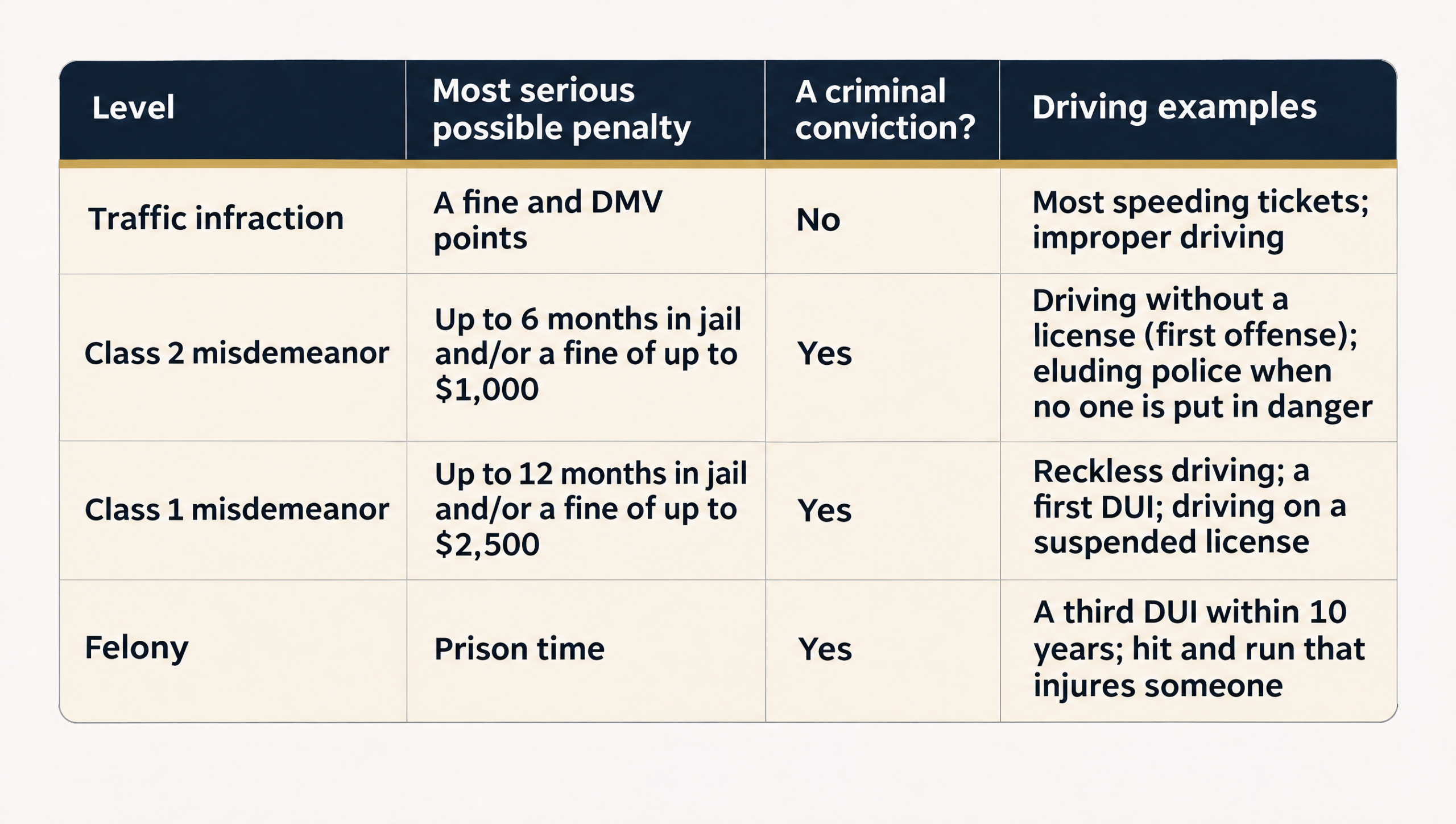
The level matters more than the fine. An infraction goes on your driving record only. A misdemeanor or felony is a criminal conviction that becomes part of your court record and can show up on criminal background checks.
When a speeding ticket becomes a misdemeanor
Under Virginia Code § 46.2-862, you can be charged with reckless driving if you drive:
- 20 mph or more over the speed limit, or
- faster than 85 mph, no matter what the limit is.
Reckless driving is a Class 1 misdemeanor (§ 46.2-868). That is the same level as a first DUI.
Hitting those numbers does not make the charge automatic. The officer decides whether to write a speeding ticket or charge reckless driving. On a 55 mph road, 75 mph can become either one.
That choice matters, and so does what happens next. A reckless charge can sometimes be reduced to improper driving, which is a traffic infraction (§ 46.2-869). Working toward that kind of result is a big part of what a defense lawyer does.
We cover the penalties and defenses in our guide to reckless driving in Virginia.

Does a speeding ticket go on your criminal record?
A regular speeding ticket does not. If you are convicted, it goes on your driving record, which the Virginia DMV keeps, and stays there for five years (Virginia DMV).
Reckless driving is different. It is a criminal conviction, so it becomes part of your public court record and can show up on criminal background checks. It also goes on your driving record, where it stays for 11 years (Virginia DMV).
One detail surprises people. Virginia does not send most traffic misdemeanors, including reckless driving, to the State Police criminal history database (§ 19.2-390). The conviction still stays in court records, and many background screening companies search those.
Do speeding tickets show up on background checks?
It depends on the kind of check.
- A criminal background check looks for criminal convictions. A speeding infraction usually does not show up.
- A driving record check, common for jobs that involve driving, does show speeding convictions.
- A reckless driving conviction can show up on both.
If you hold a commercial driver’s license, be more careful. Going 15 mph or more over the limit in a commercial vehicle counts as a “serious traffic violation” under federal and Virginia CDL rules. Two of those within three years means a 60-day CDL disqualification, and three means 120 days (49 CFR 383.51; § 46.2-341.20). A ticket in your own car can count too if it leads to a license suspension. Talk to a lawyer before you pay.
Paying the ticket vs. fighting it
Even though a regular speeding ticket is not a crime, paying it still counts. Prepaying is a guilty plea (§ 16.1-69.40:1). It adds DMV points, and it can raise your insurance for years.
Reckless driving cannot be prepaid at all. It has to go to court.
For a low-speed ticket on a clean record, paying is often reasonable. If you were near the reckless line, find out your options first. We break down the full cost in our guide to how much a speeding ticket costs in Virginia.
Our take: look past the label. A speeding conviction stays on your driving record for five years and a reckless conviction for 11, and both can follow you into insurance quotes and job applications. That long tail is the reason to get advice before you plead guilty.
If your ticket is not from Virginia
Other states sort speeding differently, and some treat certain speeding offenses as misdemeanors. If you were ticketed in another state, that state’s rules apply.
If you were ticketed in Virginia, including while passing through on I-81, this page applies even if you live somewhere else. Our guide for out-of-state drivers explains whether you have to come back.
Common questions
Is speeding a crime in Virginia?
Usually not. A regular speeding ticket is a traffic infraction, which Virginia law does not treat as a crime. Speeding becomes a crime when it is charged as reckless driving.
Is a speeding ticket a criminal offense?
No, not in most cases. It is a traffic infraction. A conviction goes on your driving record, not your criminal record.
Is a traffic infraction a misdemeanor?
No. In Virginia, a traffic infraction is a separate, lower category that is not considered criminal.
Do speeding tickets show up on background checks?
Usually not on a criminal background check. Speeding convictions do show up on a driving record check.
Is reckless driving a misdemeanor in Virginia?
Yes. Reckless driving is a Class 1 misdemeanor. Learn more in our guide to reckless driving in Virginia.
Talk to a Harrisonburg traffic lawyer
If you are holding a Virginia speeding ticket and are not sure whether it is a misdemeanor, look at the charge and the speed. If it says reckless driving, or you were close to the line, talk to a lawyer before you pay anything.
At Cook Attorneys, we handle traffic and criminal cases in Harrisonburg, Rockingham County, and across the Shenandoah Valley. Our office is at 71 Court Square, next to the courthouses. We also serve Spanish-speaking clients.
Call (540) 564-9699 or request a free consultation. You can also read more about our traffic defense practice and our criminal defense practice.
This article is general information about Virginia law, not legal advice. Laws can change, and every case depends on its own facts. Reading this post does not create an attorney-client relationship with Cook Attorneys. For advice about your situation, please speak with a licensed attorney.