Immigration Terms You Should Know

USCIS status types of immigration green card

In the United States of America, immigration applications are handled by the department of U.S. Citizenship and Immigration Services, a bureau within the Department of Homeland Security, and by the U.S. State Department. There are three primary categories of legal immigration statuses: citizens, residents, non-immigrants.

Here in this blog article, our team at Cook Attorneys in Harrisonburg, VA, will explain the types of U.S. immigration statuses and point you to a few immigration terms everyone should know.

Do keep in mind, having the support of an experienced immigration lawyer (abogado de inmigración) from the very first step of your immigration process, will significantly improve your chances for a positive outcome for your case.


UNITED STATES CITIZEN

The status of ‘United States Citizen’ applies to people who were born in the United States of America and to those who become ‘naturalized’ through the U.S. immigration process, usually after holding permanent resident status for a required period of time.

It is also possible that a person born outside the United States is a United States Citizen if one parent was a citizen at the time of birth. The rules governing citizenship in this situation are quite complicated and an immigration attorney ought to be consulted if there is a question regarding such a child’s citizenship.

Once a person is properly naturalized, that person cannot thereafter be forced to leave the United States; that is, be deported back to their home country.


PERMANENT RESIDENT

More formally classified as a Lawful Permanent Resident (LPR), Permanent Residents are aliens who have received a green card which authorizes them to live and work in the U.S.A. on a permanent basis. The status is, as it is named, permanent, but a Permanent Resident’s card must be renewed every ten years.

While Permanent Residents do enjoy many of the benefits of living in the United States, Residents do not have the civil rights exclusive to citizenship, including the right to vote, to hold public office, and to serve on juries.

The most common paths to Permanent Residency include:

  • Family sponsorship
  • Employer sponsorship
  • Refugee or Asylee status
  • Visa Lottery

Typically, Legal Permanent Resident Aliens can apply to become a naturalized U.S. Citizen after a period of five years. Conditional Residents granted green cards through marriage to a U.S. citizen can usually apply to be naturalized after just three years.

family permanent resident aliens


CONDITIONAL RESIDENT

Conditional Residents of the United States of America include alien spouses and their children who are seeking Permanent Resident status based on a qualifying marriage to a United States Citizen, or Legal Permanent Resident (LPR).

If the marriage is less than two years old at the time of being granted Permanent Residence, then the USCIS will issue the applicant a conditional green card.

The reason why the status is ‘conditional’ is because the applicant must prove that their motivation for marriage was not simply to obtain permanent residence status.

During the two year period of conditional residency, the applicant and spouse must build a record of their married relationship together in order to prove the authenticity of their intentions at the time of the marriage. Common ways to establish a bona fide marriage include joint ownership of property, the testimony of friends, and, most effective of all, the birth of a child.

Conditional Residents and their spouses must jointly file to remove the condition by submitting a Petition to Remove the Conditions on Residence (Form I-751) within two years after the receipt of a green card. Otherwise, the applicant’s green card might be revoked and the alien may face deportation.

green card family immigration attorneys in Harrisonburg, VA


NON-IMMIGRANT

Also known as a Temporary Visitor, Non-Immigrants are individuals who have received authorization by way of a visa from the United States Government which permits them to live in the U.S. for a limited period of time, and for a specific purpose.

There are many examples of the non-immigrant visas, but some very common visas include:

  • Student (F visa, J visa)
  • Work (H visa)
  • Fiancee (K visa)
  • Visiting Family (B visa)
  • Tourism (B visa)

student immigration status


UNDOCUMENTED IMMIGRANTS

Foreigners who enter the U.S. without permission or overstay their visas are often called undocumented immigrants or illegal aliens. The majority of such persons do not have authorization to work or live in the United States and will not have access to health care, a driver’s license, or other public benefits. They are at risk of deportation if they become known to authorities.

However, some undocumented immigrants do have some sort of quasi-status: DACA (Deferred Action for Childhood Arrivals) allows some students who came to the U.S. as children to work and to attend public colleges; TPS (Temporary Protected Status) allows some aliens from certain countries to stay in the U.S. and work as well.


WE CAN HELP YOU AND YOUR FAMILY WITH IMMIGRATION MATTERS

Our firm in Harrisonburg, VA has been serving families in need of immigration assistance for twenty years.

If you or someone you love is seeking to obtain a status in the United States, the process is complicated and full of pitfalls; individuals seeking to self-guide their applications without the support of an immigration lawyer can easily misstep, leading to otherwise unnecessary delays or barriers to their goal.
We can provide you with a consultation in our office about your options and the chances of success in your immigration case. Just fill out the form below to get started. We look forward to hearing from you.


Immigration Terms You Should Know

USCIS status types of immigration green card

In the United States of America, immigration applications are handled by the department of U.S. Citizenship and Immigration Services, a bureau within the Department of Homeland Security, and by the U.S. State Department. There are three primary categories of legal immigration statuses: citizens, residents, non-immigrants.

Here in this blog article, our team at Cook Attorneys in Harrisonburg, VA, will explain the types of U.S. immigration statuses and point you to a few immigration terms everyone should know.

Do keep in mind, having the support of an experienced immigration lawyer (abogado de inmigración) from the very first step of your immigration process, will significantly improve your chances for a positive outcome for your case.


UNITED STATES CITIZEN

The status of ‘United States Citizen’ applies to people who were born in the United States of America and to those who become ‘naturalized’ through the U.S. immigration process, usually after holding permanent resident status for a required period of time.

It is also possible that a person born outside the United States is a United States Citizen if one parent was a citizen at the time of birth. The rules governing citizenship in this situation are quite complicated and an immigration attorney ought to be consulted if there is a question regarding such a child’s citizenship.

Once a person is properly naturalized, that person cannot thereafter be forced to leave the United States; that is, be deported back to their home country.


PERMANENT RESIDENT

More formally classified as a Lawful Permanent Resident (LPR), Permanent Residents are aliens who have received a green card which authorizes them to live and work in the U.S.A. on a permanent basis. The status is, as it is named, permanent, but a Permanent Resident’s card must be renewed every ten years.

While Permanent Residents do enjoy many of the benefits of living in the United States, Residents do not have the civil rights exclusive to citizenship, including the right to vote, to hold public office, and to serve on juries.

The most common paths to Permanent Residency include:

  • Family sponsorship
  • Employer sponsorship
  • Refugee or Asylee status
  • Visa Lottery

Typically, Legal Permanent Resident Aliens can apply to become a naturalized U.S. Citizen after a period of five years. Conditional Residents granted green cards through marriage to a U.S. citizen can usually apply to be naturalized after just three years.

family permanent resident aliens


CONDITIONAL RESIDENT

Conditional Residents of the United States of America include alien spouses and their children who are seeking Permanent Resident status based on a qualifying marriage to a United States Citizen, or Legal Permanent Resident (LPR).

If the marriage is less than two years old at the time of being granted Permanent Residence, then the USCIS will issue the applicant a conditional green card.

The reason why the status is ‘conditional’ is because the applicant must prove that their motivation for marriage was not simply to obtain permanent residence status.

During the two year period of conditional residency, the applicant and spouse must build a record of their married relationship together in order to prove the authenticity of their intentions at the time of the marriage. Common ways to establish a bona fide marriage include joint ownership of property, the testimony of friends, and, most effective of all, the birth of a child.

Conditional Residents and their spouses must jointly file to remove the condition by submitting a Petition to Remove the Conditions on Residence (Form I-751) within two years after the receipt of a green card. Otherwise, the applicant’s green card might be revoked and the alien may face deportation.

green card family immigration attorneys in Harrisonburg, VA


NON-IMMIGRANT

Also known as a Temporary Visitor, Non-Immigrants are individuals who have received authorization by way of a visa from the United States Government which permits them to live in the U.S. for a limited period of time, and for a specific purpose.

There are many examples of the non-immigrant visas, but some very common visas include:

  • Student (F visa, J visa)
  • Work (H visa)
  • Fiancee (K visa)
  • Visiting Family (B visa)
  • Tourism (B visa)

student immigration status


UNDOCUMENTED IMMIGRANTS

Foreigners who enter the U.S. without permission or overstay their visas are often called undocumented immigrants or illegal aliens. The majority of such persons do not have authorization to work or live in the United States and will not have access to health care, a driver’s license, or other public benefits. They are at risk of deportation if they become known to authorities.

However, some undocumented immigrants do have some sort of quasi-status: DACA (Deferred Action for Childhood Arrivals) allows some students who came to the U.S. as children to work and to attend public colleges; TPS (Temporary Protected Status) allows some aliens from certain countries to stay in the U.S. and work as well.


WE CAN HELP YOU AND YOUR FAMILY WITH IMMIGRATION MATTERS

Our firm in Harrisonburg, VA has been serving families in need of immigration assistance for twenty years.

If you or someone you love is seeking to obtain a status in the United States, the process is complicated and full of pitfalls; individuals seeking to self-guide their applications without the support of an immigration lawyer can easily misstep, leading to otherwise unnecessary delays or barriers to their goal.
We can provide you with a consultation in our office about your options and the chances of success in your immigration case. Just fill out the form below to get started. We look forward to hearing from you.

White Collar Crime: Here’s The Complete Explanation

white collar crime local criminal attorneys

Some law firms will advertise online that their criminal defense practice is limited to so-called “white collar crime” while others, like Cook Attorneys, include “white collar crime” in a list of many areas of criminal law in which we regularly work.
Here in this article, our local criminal defense attorneys will briefly help you understand what is meant by the term “white collar crime.”

HISTORY OF THE TERMS WHITE COLLAR AND BLUE COLLAR

The terms “white collar” and “blue collar” originated in the early 1900s as a generalization for job categories of the U.S. workforce.

“White collar” referred to the white dress shirts typically worn by professionals or office workers, whereas its counterpoint, “blue collar,” referred to individuals employed as manual laborers.
The term “blue collar” described the blue uniforms commonly worn by industrial and manual laborers; blue denim shirts and overalls helped to conceal dirt or grease stains from the workplace.

These terms also implied socio-economic differences. It was once assumed that “white collar” workers were more highly educated or more affluent than “blue collar” workers.

These stereotypes are no longer accurate in our modern economy; low-paid office workers comprise a large percentage of the U.S. workforce, and highly skilled and compensated manual laborers are vital to countless industries.
However, the terms “white collar” and “blue collar” are still commonly used in many situations, including in the use of the term “white collar crime.”

original meaning white and blue collar crime


WHITE COLLAR CRIME

“White collar crime” is not a term you will find in the criminal code or elsewhere formally defined in the law. Rather, it is a designation in everyday English for financially motivated, pre planned, non-violent crimes.
Referring back to the previously-mentioned white collar vs blue collar stereotypes of office workers versus manual laborers, we think of white collar crimes as tending to have been committed by professionals, often in the course of financial dealings, or a business enterprise.
A white collar crime can be either a felony or a misdemeanor.

Here are a few examples of crimes that often come to mind when thinking about white collar crimes:

  • Computer fraud
  • Conspiracy
  • Corporate fraud
  • Credit card fraud
  • Embezzlement
  • Forgery
  • Identity Theft
  • Money laundering
  • Racketeering (RICO)
  • Securities fraud
  • Tax evasion
  • Wire fraud

Crimes like these, of course, can be committed by individuals of all socio-economic statuses, education levels, and working backgrounds, but we hear them called “white collar crimes” when they are committed by professionals, politicians, or businesses.
And it is in that context that we turn to the investigation of white collar crimes.

criminal defense attorney in Harrisonburg, VA


THE INVESTIGATION OF WHITE COLLAR CRIMES

One feature of most white collar criminal activity is that it normally requires extensive investigation to, first of all, discover, and, second, to prove beyond a reasonable doubt. And white collar crimes require extensive investigation to defend.

White collar crimes in Virginia may be investigated by detectives in a local police department, at least initially, but many such investigations are referred to the Bureau of Criminal Investigation of the Virginia State Police.
White collar investigations often include voluminous and technical documentation which most local police departments are not sufficiently staffed to handle, or require specialized training in fields such as accounting or banking, for example, which local police detectives do not have.
At the federal level, white collar investigations are often conducted by the FBI, the Securities and Exchange Commission (SEC), the National Association of Securities Dealers (NASD), and other appropriate federal agencies.
Once a white collar investigation is underway, the target of the investigation should consult with a criminal defense attorney as soon as possible.
The defense needs to investigate the accusation just as much (or more) than law enforcement does, because although a criminal defendant is not legally required to prove anything at trial, a thorough investigation is often required to mount an effective defense to the accusation of a white collar crime.

Lawyers who advertise that they regularly defend white collar criminal cases are signalling that they are prepared and able to commit the resources to the investigation and defense of such cases.
The fee the lawyer quotes will often include funds to pay expenses for experts such as forensic accountants or other expert witnesses. Most criminal defense lawyers, because they cannot or are not willing to commit those resources, should not accept representation in a white collar case.

When interviewing potential lawyers at the outset of such cases, clients should discuss with the attorney the attorney’s experience with investigating and defending white collar crimes. Importantly, clients should also discuss the attorney’s experience with defending crimes generally; some lawyers who normally practice only civil law try their hand in white collar cases with disastrous outcomes.
While many of the financial and documentary issues may look like those in a civil case, the world of criminal defense is quite different and full of pitfalls to an attorney who does not regularly practice criminal law or in a particular jurisdiction.

ENSURE THE BEST POSSIBLE OUTCOME FOR YOUR CASE

Our attorneys in Harrisonburg, VA bring decades of experience to our clients facing criminal charges, including white collar crimes. If you’re searching for an effective criminal defense lawyer in western Virginia, we encourage you to contact us for a free criminal case consultation. Fill out the form below to request more information about how we can serve you.

We look forward to hearing from you!


White Collar Crime: Here’s The Complete Explanation

A hooded figure in dark background that represents blue collar crime.

Some law firms will advertise online that their criminal defense practice is limited to so-called “white collar crime” while others, like Cook Attorneys, include “white collar crime” in a list of many areas of criminal law in which we regularly work. 


Here in this article, our local criminal defense attorneys will briefly help you understand what is meant by the term “white collar crime.”


BLUE COLLAR VS WHITE COLLAR TERMS


The terms “white collar” and “blue collar” originated in the early 1900s as a generalization for job categories of the U.S. workforce.

“White collar” referred to the white dress shirts typically worn by professionals or office workers, whereas its counterpoint, “blue collar,” referred to individuals employed as manual laborers.

The term “blue collar” described the blue uniforms commonly worn by industrial and manual laborers; blue denim shirts and overalls helped to conceal dirt or grease stains from the workplace. 


These terms also implied socio-economic differences. It was once assumed that “white collar” workers were more highly educated or more affluent than “blue collar” workers.


These stereotypes are no longer accurate in our modern economy; low-paid office workers comprise a large percentage of the U.S. workforce, and highly skilled and compensated manual laborers are vital to countless industries. 


However, the terms “white collar” and “blue collar” are still commonly used in many situations, including in the use of the term “white collar crime.”

original meaning white and blue collar crime

BLUE COLLAR CRIME

Sometimes known as “street crimes,” blue collar crimes generally involve violence, sexual activities, and/or drugs. Generally, the stereotype is that blue collar crimes are committed by people in a lower economic class, and are powered by necessity and emotion/passion. 


The blue collar crimes definition can sometimes be hard to tell apart from white collar crimes, especially in mafia circles, but some standard blue collar charges are:

  • Arson
  • Assault
  • Burglary/shoplifting
  • Destruction of property
  • Drug crimes
  • Manslaughter
  • Murder
  • Prostitution
  • Retail fraud
  • Sex crimes


Most of these crimes are ones that police can see someone committing or have blatant evidence that someone committed, resulting in an arrest. They are not usually uncovered with some large, hidden scheme by detectives.


WHITE COLLAR CRIME

“White collar crime” is not a term you will find in the criminal code or elsewhere formally defined in the law. Rather, it is a designation in everyday English for financially-motivated, pre-planned, non-violent crimes. 


Referring back to the previously-mentioned white collar vs blue collar stereotypes of office workers versus manual laborers, we think of white collar crimes as tending to have been committed by professionals, often in the course of financial dealings, or a business enterprise. 


A white collar crime can be either a felony or a misdemeanor. 

Here are a few white collar crime examples :


  • Computer fraud
  • Conspiracy 
  • Corporate fraud
  • Credit card fraud
  • Embezzlement
  • Forgery
  • Identity Theft
  • Money laundering
  • Racketeering (RICO)
  • Securities fraud
  • Tax evasion
  • Wire fraud


Crimes like these, of course, can be committed by individuals of all socio-economic statuses, education levels, and working backgrounds, but we hear them called “white collar crimes” when they are committed by professionals, politicians, or businesses. 


And it is in that context that we turn to the investigation of white collar crimes. 


criminal defense attorney in Harrisonburg, VA


THE INVESTIGATION OF WHITE COLLAR CRIMES


One feature of most white collar criminal activity is that it normally requires extensive investigation to discover and to prove beyond a reasonable doubt. Additionally, white collar crimes require extensive investigation to defend.


White collar crimes in Virginia may be investigated by detectives in a local police department, at least initially; but many such investigations are referred to the Bureau of Criminal Investigation of the Virginia State Police. 


White collar investigations often include voluminous and technical documentation which most local police departments are not sufficiently staffed to handle, or require specialized training in fields such as accounting or banking, for example, which local police detectives do not have. 

At the federal level, white collar investigations are often conducted by the FBI, the Securities and Exchange Commission (SEC), the National Association of Securities Dealers (NASD), and other appropriate federal agencies.


Once a white collar investigation is underway, the target of the investigation should consult with a criminal defense attorney as soon as possible. 


The defense needs to investigate the accusation just as much (or more) than law enforcement does, because although a criminal defendant is not legally required to prove anything at trial, a thorough investigation is often required to mount an effective defense to the accusation of a white collar crime.   


Lawyers who advertise that they regularly defend white collar criminal cases are signaling that they are prepared and able to commit the resources to the investigation and defense of such cases. 


The fee the lawyer quotes will often include funds to pay expenses for experts such as forensic accountants or other expert witnesses. Most white collar crime lawyers cannot or are not willing to commit those resources, and you should not accept their representation in your case. Look for a lawyer like the ones at Cook Attorneys who will use all the resources they can to build your case.


When interviewing potential white collar crime lawyers at the outset of such cases, clients should discuss with the attorney the attorney’s experience with investigating and defending white collar crimes. Importantly, clients should also discuss the attorney’s experience with defending crimes generally; some lawyers who normally practice only civil law try their hand in white collar cases with disastrous outcomes. 


While many of the financial and documentary issues may look like those in a civil case, the world of criminal defense is quite different and full of pitfalls to an attorney who does not regularly practice criminal law or who does not normally work in a particular jurisdiction.


ENSURE THE BEST POSSIBLE OUTCOME FOR YOUR CASE


Our attorneys in Harrisonburg, VA bring decades of experience to our clients facing criminal charges, including white collar crimes.  If you’re searching for effective white collar crime attorneys  in western Virginia, we encourage you to contact us for a free criminal case consultation. Fill out the form below to request more information about how we can serve you. 


We look forward to hearing from you!


What is Worse: A DUI or DWI?

dui vs dwi

The shortcuts “DWI” and “DUI” are both frequently used when referring to drunk driving. Which one is worse? A DWI? Or a DUI?

“DUI” stands for the charge of Driving Under the Influence of alcohol or drugs, and “DWI” stands for Driving While Intoxicated by alcohol or drugs. So which one is more severe or of greater consequence?

This, of course, is a trick question. The terms are completely interchangeable and usually depend on how each state has written its drunk driving statute. Here in Virginia, the Code at 18.2-266 criminalizes operating a motor vehicle while “under the influence” of alcohol or drugs, and yet the heading or title of the code section refers to “driving while intoxicated.” Therefore, both terms equally apply to a drunk driving charge in Virginia, and local custom will likely determine which label is used by practitioners in a given jurisdiction or around a particular courthouse.

Our attorneys in Harrisonburg, VA regularly defend clients charged with driving while under the influence of alcohol and would be happy to meet with you if you have been charged here in Rockingham County or throughout the Shenandoah Valley.

OPERATING A MOTOR VEHICLE

The first element of the offense of DUI/DWI is the element of operation, which questions whether the accused was indeed ‘operating’ a motor vehicle. 

Operation has been defined quite broadly in Virginia to include not only driving a vehicle, but also sitting in the driver’s seat with the key in the ignition while the engine is off, grabbing the steering wheel while someone else was driving, or sitting behind the wheel of an inoperable motor vehicle.

UNDER THE INFLUENCE OR INTOXICATION

Being intoxicated or under the influence is defined in Virginia as “a condition in which a person has drunk enough alcohol beverages to observably affect his manner, disposition, speech, muscular movement, general appearance, or behavior.” 

Intoxication can be proven through the defendant’s statements, the observations of a witness (including a police officer), poor performance on standardized field sobriety tests, and/or an approved chemical test to show the amount of alcohol in the driver’s system.

Under Virginia law, if the chemical test indicates that a driver’s blood-alcohol content (BAC) is 0.08% or greater, the judge can use that information to infer that the driver was under the influence of alcohol at the time of the driving. 

If the driver’s BAC is greater than 0.15%, then Virginia law mandates certain minimum jail sentences that the judge must impose. For drivers under the age of 21, a BAC between 0.02% and 0.08% can result in a criminal conviction for a “baby DUI”—that is, for driving while alcohol is present even if the driver is not intoxicated.

difference between dwi and dui

DRIVING WHILE UNDER THE INFLUENCE OF DRUGS IN VIRGINIA

As mentioned previously, intoxication in Virginia may be the result of consuming alcohol, or it may be the result of using drugs, including prescribed medicine. If a driver knowingly takes medicine, even if legally prescribed by a doctor, and that medicine causes them to be “intoxicated” as defined above, that driver can be found guilty of DUI/DWI. And, of course, illegal drugs can cause a driver to be “intoxicated” as well.

While the chemical test for blood alcohol content has been part of the law for many years, the Virginia legislature in recent years has added rebuttable presumptions to the DUI/DWI statute for some illegal drugs, including methamphetamine (a blood concentration of .1 milligrams per liter or more), cocaine (a blood concentration of .02 milligrams per liter or more), PCP (a blood concentration of .01 milligrams per liter or more), and MDMA (a blood concentration of .1 milligrams per liter or more).

These Virginia DUI/DWI laws aim to prevent someone who is impaired by alcohol or drugs from unsafely operating their vehicle which could cause harm to themselves or others.

DRUNK DRIVING STATISTICS IN THE US

According to the CDC, every day, approximately 29 people in the United States die in motor vehicle crashes that involve an alcohol-impaired driver. This is one death every 50 minutes. The annual cost of alcohol-related crashes in the United States totals more than $44 billion.

which is worse dui or dwi

ARE YOU SEARCHING FOR THE BEST DUI/DWI LAWYERS IN THE SHENANDOAH VALLEY OF VIRGINIA?

When you need a Harrisonburg DUI Attorney

If you or someone in your family has been charged with Driving Under the Influence in the Shenandoah Valley, then you need to seek a Harrisonburg criminal defense attorney. 

WE CAN HELP YOU TO IMPROVE YOUR FUTURE OUTCOME

A first-time DUI arrest in Virginia is classified as a misdemeanor and can negatively impact your future in a variety of ways. Our team of DUI Lawyers in Harrisonburg, VA can help you achieve the best possible outcome for your case.

harrisonburg DUI lawyers

WHAT TO EXPECT FROM THE COURTS

Every state’s DWI rules are different, and Virginia is strict in its enforcement of drunk driving laws. If convicted, your driver’s license will be suspended and you could go to jail for up to 12 months and be fined up to $2,500. 

You will also be required to go to a remedial Virginia Alcohol Safety Action Program. If your blood alcohol level was more than 0.15% at the time of your arrest, your sentence will include mandatory jail time. 

Punishments are more severe if your drunk driving causes injury to someone or if you are a repeat offender. A third DUI within ten years is a felony.

HERE ARE THE EASY NEXT STEPS

We invite you to schedule a FREE initial consultation with our lawyers in Harrisonburg, Virginia. We have Spanish speaking attorneys and can help you to hire a translator if you need legal assistance in any other language. 

Consultations typically require less than one hour, during which time we will review your case and advise on next steps. 

Contact us to learn more about how we can help you to achieve the best possible outcome for your case.

If you or someone you love is facing DWI/DUI charges in Harrisonburg, Virginia or the surrounding area, we can help you to achieve the best possible outcome for your case. We invite you to contact us to schedule a free consultation. Se habla español.

Fill out the form below to request more information about how we can serve you. We look forward to hearing from you!

How Long Does The Immigration Process Take In The US?

immigration consultation from Harrisonburg lawyers

At Cook Attorneys, our team of lawyers in Harrisonburg, VA have decades of experience helping individuals and families in the Shenandoah Valley of Virginia with immigration matters.


Many clients, when contemplating the filing of a petition or application with U.S. Immigration, ask their immigration lawyer (abogado inmigración), “How long does the immigration process take in the U.S.?”


HOW LONG DOES THE IMMIGRATION PROCESS TAKE IN THE US?


The answer to this question will be different in every individual’s case. The U.S. immigration process is very complex. The laws are complicated and confusing for most people, and the procedures are difficult and confusing to navigate. Demand for U.S. immigration is high, so many delays are the result of an overworked bureaucracy. And there are long backlogs built into the system due to arbitrary quotas imposed by Congress on many categories of would-be immigrants. Depending on the type of visa you qualify for, and your country of origin, the time it can take to obtain approval can vary between a year and a lifetime. Literally.


That’s why it’s such a big risk to attempt to self-guide your application without the advice and assistance of an immigration lawyer. It is too easy to make a mistake—even a minor one—in a process which can result in the additional delay or even denial of your application.


We recommend you enlist the assistance of an immigration attorney, since there are many reasons why you shouldn’t “DIY” your immigration process.

How Long Does The Immigration Process Take In The US?

WHAT TYPES OF US IMMIGRATION VISAS ARE AVAILABLE?


Family-Based Immigration
Family unification plays a major role in US Immigration. US citizens and Legal Permanent Residents (LPR) can apply to bring certain family members to America. These include:

  • Spouses of US citizens and LPRs
  • Unmarried children of US citizens and LPRs 
  • Parents of adult US citizens 
  • Married children of US citizens
  • Siblings of adult US citizens


Employment-Based Immigration
The US offers several channels through which immigrants with desirable skills can apply for US Immigration:

  • Temporary Visa Classifications
  • Permanent Immigration for certain jobs


Adoption

For US citizens adopting children from foreign countries.


Special Immigrant
These include but are not limited to

  • Religious workers
  • Employees of US foreign service posts
  • Former US government employees


Diversity Visa
A lottery which annually provides 55,000 randomly allocated visas to nationals from countries that have sent fewer than 50,000 immigrants to the United States in the previous five years.


Asylum …and more.


For a detailed list of the types of US immigration visas available, you can visit the website of the US Department of State’s Bureau of Consular Affairs.

immigration processing times

WHAT INFLUENCES THE WAIT TIME FOR THE U.S. IMMIGRATION PROCESS?


Delays in the process to obtain an immigrant visa, generally speaking, can be blamed on three factors.


The first is the time it takes to process your paperwork which will vary according to the number of applications that are ahead of you. USCIS publishes and regularly updates the expected processing times online where you can discover, for example, that an application for a work permit filed by one who is also applying from Virginia for a green card (LPR) will take about 5-7 months to process.


A second reason for delay in the application process is for requests for additional information after the application is initially processed and reviewed. Sometimes an application is incomplete or missing certain required documentation, and sometimes it seems that USCIS requests additional information just to confirm that circumstances haven’t changed since the initial filing.


A third reason for delay is that for many immigration statuses there is a limit on the number of visas available in a certain category, based on an annual cap imposed by Congress. For example, a quota has been imposed on the total number of green cards available each year in most categories, and Congress has further limited the number of green cards per country of origin. Under current law, applicants from no single country can exceed seven percent of the total number of people immigrating to the United States in a single fiscal year. The countries which typically reach this maximum number each year and cause a backlog to their national applicants are China, India and the Philippines.


Suppose a U.S. citizen applies for a sibling to obtain permanent residency in the United States. The date on which USCIS receives the citizen’s petition is labeled as the “priority date,” and the foreign sibling is permitted to file an application for a green card when that “priority date” becomes “current.” As of April, 2020, that sibling has reached the front of the line and can now file an application if the “priority date” of the citizen’s petition is on or before July 1, 2006—unless the sibling is a national of India (December 22, 2004), the Philippines (May 1, 2000), or Mexico (March 15, 1998). Yes, you are reading that correctly: a Mexican sibling whose U.S. citizen sibling filed on his behalf 22 years ago can finally take the next step to file an application to obtain lawful permanent residence, which will take at least another six months to process, at which time the sibling will then (finally!) be able to enter the United States.


WE CAN HELP YOU WITH YOUR IMMIGRATION PROCESS


Much of the information online about immigration to the United States is incorrect or is misunderstood by the person who posted it. Immigration law is full of nuance and caveats which means that the correct answer in one case may not be the correct answer in your case.


In addition, there are lawyers and non-lawyers who wittingly or unwittingly lead clients astray or, in the worst cases, take advantage of people desperate for news they want to hear. 


Our licensed attorneys can provide you with a confidential immigration consultation to help you understand your options and to help you to receive honest information you can trust. 


For nearly 20 years, we’ve assisted immigrants to adjust their status, apply for family members, petition for naturalization and obtain asylum to stay in the United States. We can help you and your family as well.


Fill out the form below to request more information about how we can serve you. We look forward to hearing from you!

Criminal Intent: What Everyone Should Know

inside the criminal mind


“Mens rea” comes from the Latin and is used by lawyers to designate the criminal intent that must be proven beyond a reasonable doubt to gain a conviction in a criminal case. In every criminal case, certain actions or conduct must be shown to have occurred, and in many cases, some form of criminal intent must also be proven.


Criminal offenses that require no proof of criminal intent are called “strict liability” crimes. The prosecutor is not required to prove any level of criminal intent in a strict liability case. Normally, crimes require a culpable mental state, but legislators sometimes want to punish acts regardless of the defendant’s intent, putting the onus on the persons acting to make sure they are not violating the law. Examples of strict liability cases include most traffic violations, statutory rape and selling alcohol to a minor. Saying that you didn’t know you were speeding or that the beer-purchaser was under 21 is not a legal defense to those charges. 

When our Harrisonburg lawyers defend a client in a criminal case, we must always be mindful of the requisite criminal intent charged in the warrant and attempt to understand the evidence the prosecutor intends to present to prove that intent.  


THE FOUR DIFFERENT KINDS OF CRIMINAL INTENT


Criminal intent, generally speaking, refers to someone’s state of mind at the time of her criminal action. Someone making a conscious decision to intentionally do something that is wrong or forbidden by the law possesses criminal intent. In other words, they are fully aware that their actions are wrong and are subject to consequences, yet they deliberately proceed with their intended actions anyway.


There are four ways the law speaks about levels of criminal intent. Forms of these words can be found in many criminal statutes and indicate which level of criminal intent applies to a particular crime.


  1. Purposeful or Willful
    Committed by a person who is fully aware of the intended consequences of their actions and who wants to see the result come to fruition.
  2. Knowing
    Committed by someone who is aware of the consequences that may result, but it is not necessarily with the purpose to cause the result.
  3. Reckless
    Committed by a person who consciously disregards the consequences of their actions.
  4. Criminally Negligent
    Committed by someone who fails to act as a reasonable individual in a given situation which results in harm to others. Criminal negligence is a higher level of negligence than is required in civil tort law.


SPECIFIC VS. GENERAL INTENT IN A CRIMINAL CASE


The law also divides criminal intent into “general” and “specific” intent. To prove specific intent is the same as proving purposeful criminal intent in that it must be demonstrated that the defendant not only intended to commit a guilty act but also intended the consequences of the act. An act undertaken with specific intent requires an intent to achieve a specific result. General intent, on the other hand, requires only the intent to commit the illegal act.


Examples of specific intent crimes include first-degree murder, larceny, and embezzlement as well as inchoate crimes such as attempt, solicitation, and conspiracy. Assault and battery, manslaughter, DUI and arson are examples of general intent crimes.


HOW IS CRIMINAL INTENT PROVEN IN COURT?


How does a prosecutor prove that a defendant’s state of mind was to intentionally commit a crime? Many suspects make it easy for the prosecutor by fully confessing to the police. A well-trained police officer will ask the right questions to nail down the suspect’s intent at the time he committed the crime.


Where there is no confession, however, the prosecutor normally attempts to convince the judge or the jury of a defendant’s criminal intent through inference. They will comb through all the known circumstances, including the accused’s behavior and spoken or written words as well as testimony from witnesses statements who can attest to the defendant’s actions and perceived mental state at the time of the crime. 


Where there is a mens rea requirement, the law requires that a jury be convinced beyond a reasonable doubt that the inference establishes the criminal intent necessary to convict. Criminal intent is an element of the crime to be proven just like the other elements focused on the alleged actions taken by the defendant. 


criminal lawyers in Harrisonburg, VA looking at the brain


LET US MEET WITH YOU FOR A FREE CRIMINAL DEFENSE CONSULTATION


If you or someone you know is in need of a local criminal defense attorney, our Harrisonburg criminal attorneys offer free initial consultations for most criminal defense clients. 

You can learn more about what to expect from our free criminal defense consultations.


Our team at Cook Attorneys hopes to have the opportunity to support you in ensuring the best possible outcome for your case. Fill out the form below to request more information about how we can serve you. Se habla español. We look forward to hearing from you!

Self Defense in Virginia: All Explained

self-defense blogs by criminal lawyers in virginia


When our team of VA criminal lawyers provides free criminal defense consultations to potential clients who are seeking a local criminal defense attorney, some cases require us to explore the possibility that self-defense might be a plausible issue to raise as a defense to a criminal charge. Self-defense is a nuanced concept and not as applicable as most people think, but we’ll try to provide you with a bit of clarity about the right to self-defense in Virginia in this post.


WHAT IS SELF DEFENSE?


Self-defense is the right to protect one’s person or property against some injury attempted by another. For centuries, that right was sacrosanct, but modern courts have chipped away at the right to defend one’s self and one’s property so that in many situations self-defense is no longer a legal defense to a crime.


State and federal courts still pay lip service to the right to self-defense, but as a practical matter, modern judges and juries often do not recognize the right when asked to acquit a person who in fact acted in self-defense. Nevertheless, the defense is still a legal defense to a criminal charge when a person believes another is about to commit an assault against him, his property or against another person.


JUDICIAL CONSIDERATIONS WHEN EVALUATING A SELF DEFENSE CLAIM


When considering the validity of a self-defense claim, judges and juries have numerous questions to consider. For example:


  • What is a sufficient level of force or violence for someone to use when defending themselves or others?
  • What goes beyond that level? 
  • What if the intended victim provoked the attack? 
  • Is it the responsibility of the intended victim to try to flee from the violence if possible?
  • Was the threat real or only perceived?


Over time, specific criteria have been developed which must be considered in order for a claim of self-defense to be vindicated in the courts.


CRITERIA FOR A SELF DEFENSE CLAIM


Imminent Threat


Generally, self-defense or defense of others is only considered to be justifiable in the face of an imminent threat. Imminence can be displayed through spoken words that imply a threat of violence or through an actual physical display of force. 


It should be noted that a self-defense claim is only justifiable during the time in which a threat is ongoing. After the threat has ceased, the use of force is no longer appropriate and would be considered as an act of retaliation as opposed to self-defense.


Reasonable Fear


In addition to facing an imminent threat, self-defense (or defense of others) requires a reasonable fear to justify an act of force or violence. 


But what level of fear can be considered to be “reasonable”? Judges and juries are instructed to apply a “reasonable person standard” which asks what an ordinary and reasonable individual would perceive under the same circumstances. 


There are times when self-defense can be justified even if the victim incorrectly believed that a threat was imminent. What matters is whether a “reasonable person” in the same circumstance would have also felt reasonable fear they were in danger of immediate harm. 


Proportional Force


When considering the validity of self-defense (or defense of others) claim, judges and juries must also consider whether the force used by the defendant was proportional to the threat perceived; that is, was the force used to repel the attack no more than was reasonably necessary under the circumstances as they appeared to the defendant?  


For example, if the defendant was threatened with a baseball bat and chose to defend himself by shooting the aggressor, this might not qualify as self-defense on the ground that the force used in defense was not proportional to the attack. However, if the defendant had a reasonable fear that they were about to be shot and shoots back at the perpetrator, then this could be justified as a reasonably necessary force.


Duty to Retreat 


Virginia and many other states require a defendant, if he was to some degree at fault in provoking the initial attack, to have made an effort to retreat as far as safely possible in a good faith attempt to avoid a fight and make known his desire for peace before he can invoke self-defense. In these cases where the defendant is determined to be at fault, reasonable force, including deadly force, is only justified if the defendant can prove that he first tried to abandon the situation as a means of resolving the imminent threat. 


self defense lawyers in Harrisonburg, VA


DO YOU THINK YOU MIGHT HAVE A SELF DEFENSE CLAIM?


Situations in which persons can defend themselves and the amount of force they are allowed to use can be complicated. Everything can be made much simpler with the advice and advocacy of an effective local criminal defense attorney. 


If you or someone you know is in need of a Harrisonburg criminal attorney, start by contacting our team at Cook Attorneys. We offer free initial consultations for most criminal defense clients.


Our team at Cook Attorneys hopes to have the opportunity to support you in ensuring the best possible outcome for your case. Fill out the form below to request more information about how we can serve you. Se habla español. We look forward to hearing from you!

Self Defense in Virginia: How Is It Defined And When Can It Be Used in a Criminal Case?

self-defense blogs by criminal lawyers in virginia


When our team of VA criminal lawyers provide free criminal defense consultations to potential clients who are seeking a local criminal defense attorney, some cases require us to explore the possibility that self defense might be a plausible issue to raise as a defense to a criminal charge. Self defense is a nuanced concept and not as applicable as most people think, but we’ll try to provide you with a bit of clarity about self defense laws in Virginia in this post.


WHAT IS SELF DEFENSE?


Self-defense is the right to protect one’s person or property against some injury attempted by another. For centuries, that right was sacrosanct, but modern courts have chipped away at the right to defend one’s self and one’s property so that in many situations self defense is no longer a legal defense to a crime.


State and federal courts still pay lip service to the right to self defense, but as a practical matter, modern judges and juries often do not recognize the right when asked to acquit a person who in fact acted in self defense. 

Nevertheless, the defense is still a legal defense to a criminal charge when a person believes another is about to commit an assault against him, his property, or another person.


JUDICIAL CONSIDERATIONS WHEN EVALUATING A SELF DEFENSE CLAIM


When considering the validity of a self defense claim, judges and juries have numerous questions to consider. For example:


  • What is a sufficient level of force or violence for someone to use when defending themselves or others?
  • What goes beyond that level? 
  • What if the intended victim provoked the attack? 
  • Is it the responsibility of the intended victim to try to flee from the violence if possible?
  • Was the threat real or only perceived?


Over time, specific criteria have been developed which must be considered in order for a claim of self defense to be vindicated in the courts.


VIRGINIA SELF DEFENSE LAWS


Imminent Threat

Generally, self defense or defense of others is only considered to be justifiable in the face of an imminent threat. Imminence can be displayed through spoken words, which imply a threat of violence or through an actual physical display of force. 


It should be noted that a self defense claim is only justifiable during the time in which a threat is ongoing. After the threat has ceased, the use of force is no longer appropriate and would be considered as an act of retaliation as opposed to self defense.


Reasonable Fear

In addition to facing an imminent threat, self defense (or defense of others) requires a reasonable fear to justify an act of force or violence. 


But what level of fear can be considered to be “reasonable”? Judges and juries are instructed to apply a “reasonable-person standard” which asks what an ordinary and reasonable individual would perceive under the same circumstances. 


There are times when self defense can be justified even if the victim incorrectly believed that a threat was imminent. What matters is whether a “reasonable person” in the same circumstance would have also felt reasonable fear they were in danger of immediate harm. 


Proportional Force

When considering the validity of a self defense (or defense of others) claim, judges and juries must also consider whether the force used by the defendant was proportional to the threat perceived; that is, was the force used to repel the attack no more than was reasonably necessary under the circumstances as they appeared to the defendant?  


For example, if the defendant was threatened with a baseball bat and chose to defend himself by shooting the aggressor, this might not qualify as self defense on the ground that the force used in defense was not proportional to the attack. However, if the defendant had reasonable fear that they were about to be shot and shoots back at the perpetrator, then this could be justified as reasonably necessary force.


Duty to Retreat 

Virginia and many other states require a defendant, if he or she was to some degree at fault in provoking the initial attack, to have made an effort to retreat as far as safely possible in a good faith attempt to avoid a fight and make known his or her desire for peace before they can invoke self defense. 

In these cases where the defendant is determined to be at fault, reasonable force, including deadly force, is only justified if the defendant can prove that they first tried to abandon the situation as a means of resolving the imminent threat.


self defense lawyers in Harrisonburg, VA


STAND YOUR GROUND IN VIRGINIA


Because of the Virginia “Stand your ground” law, you can still make a self-defense claim even if you did not retreat before defending yourself. This only stands if every other qualification of self-defense is true.

Virginia deadly force laws state that whether or not you retreat or “stand your ground,” you can only use self-defense as justification for killing someone else if there was actual deadly danger present (not, for instance, if the person just used words to threaten you). 

It can be complicated and a bit confusing to navigate Virginia law on deadly force and self defense. Even as a “Stand Your Ground” state, the use of deadly force in Virginia is a very serious situation. 

If you have questions about the “Stand Your Ground” law in Virginia or any other self-defence matter, please contact Cook Attorneys immediately and let us help you know your options. 


DO YOU THINK YOU MIGHT HAVE A SELF DEFENSE CLAIM?


Situations in which persons can defend themselves and the amount of force they are allowed to use can be complicated. Everything can be made much simpler with the advice and advocacy of an effective local criminal defense attorney. 


If you or someone you know is in need of a lawyer for self defense law in Virginia, start by contacting our team at Cook Attorneys. We offer free initial consultations for most criminal defense clients.


Our team at Cook Attorneys hopes to have the opportunity to support you in ensuring the best possible outcome for your case. Fill out the form below to request more information about how we can serve you. Se habla español. We look forward to hearing from you!

What is the Role of a Prosecutor in Virginia?

prosecutors and criminal defense lawyers


Our legal system in the United States and here in Virginia is an adversarial system, built on the foundational proposition that truth and justice will prevail most often when two sides to a dispute do battle in the courtroom, submitting their best arguments to a judge or a jury who will then make a reasoned decision to resolve the case. The system assumes that both sides are capably and competently represented by their lawyers; in a criminal case, those lawyers are the prosecutor and the criminal defense attorney.

Within this adversarial system, the lawyers at Cook Attorneys in Harrisonburg defend our clients who have been accused of committing crimes. This article will discuss the role of a prosecutor in this system and in the prosecution of criminal cases in Virginia.


PROSECUTORS VS DEFENSE LAWYERS


The American Bar Association answers the question, “What is a prosecutor?” by saying that it is a prosecutor’s job to protect the innocent and seek justice within the bounds of the law. 

A prosecutor is a lawyer who works to seek justice for the community.


Who is a prosecutor’s client?

If a prosecutor is operating ethically, their client is the public and not any government agency. They do not represent the members of law enforcement who have worked on the case. Just the same, their client is not the crime victim or the crime victim’s family. 

Above all, the prosecutor is to remain motivated by justice for all members of the public, including the accused.


ARE PROSECUTORS ELECTED OR APPOINTED IN VIRGINIA?


In Virginia, prosecutors are constitutional officers elected by the people to be the Commonwealth’s Attorney. Each jurisdiction—that is, each county and independent city—elects the Commonwealth’s Attorney every four years.  

For reasons of history, some Commonwealth’s Attorneys are elected by combined jurisdictions; for example, Harrisonburg and Rockingham County in Virginia elect a single chief prosecutor.

However, neighboring Augusta County elects a Commonwealth’s Attorney as do the cities of Waynesboro, VA and Staunton, VA which are located within the borders of Augusta County.


WHAT IS THE  ROLE  OF THE PROSECUTOR VS THAT OF DEFENSE ATTORNEYS?


The prosecutor’s role is to accuse the defendant with a specific crime or set of crimes. The prosecutor will then seek to prove beyond a reasonable doubt that the defendant is guilty.
The defense attorney’s role is to represent the accused individual or corporation, defending them against those charges. The defendant is innocent until proven guilty by the prosecutor’s evidence. 

The Commonwealth’s Attorney serves as the attorney for the government in criminal prosecutions as well as in a limited number of civil and administrative proceedings.
The job of the prosecutor is to represent the interests of her client, the Commonwealth of Virginia, but—in addition—the prosecutor has special ethical duties beyond the ethical duties of other lawyers to see that justice is done.
The prosecutor, for example, cannot not continue to pursue a criminal charge that is not supported by probable cause.
The prosecutor cannot encourage anyone to withhold information from a criminal defense attorney, and the prosecutor has a duty to make timely disclosure of evidence which tends to negate the guilt of the accused, mitigate the degree of the offense, or reduce the punishment.


WHAT AUTHORITY DOES THE PROSECUTOR HAVE?


The Commonwealth’s Attorney cannot see herself as the attorney for the “victim” of a crime or for the police; the prosecutor’s client, ultimately, is Justice itself.

This is very important as the prosecutor is in fact the most powerful person in the courtroom and in the criminal justice system as a whole—more powerful even than the judge.
The prosecutor decides what accusations to make, and many charges currently carry minimum sentences, some mandatory, that can tie the hands of the judge or jury.
The vast majority of criminal cases—more than 90% of felony cases—end in a plea agreement, the terms of which are written by the prosecutor and merely accepted by the judge.
Clamoring in Harrisonburg and Rockingham County over recent years for changes in the criminal justice system and for a “criminal justice planner” is well-meaning but misguided; the criminal justice planner is the Commonwealth’s Attorney, and any desired changes by those currently seeking change in our local implementation of the criminal law can only be made by the Commonwealth’s Attorney (and, perhaps, to a lesser degree, our local judges).


ASSISTANT PROSECUTORS


Most Commonwealth’s Attorneys in Virginia hire one or more assistants to assist in the prosecution of criminal cases.
Here in Harrisonburg, our Commonwealth’s Attorney has a stable of approximately a dozen lawyers who are tasked to assist the Commonwealth’s Attorney in the prosecution of criminal offenses.
Most of our cases, then, are prosecuted by assistants rather than by the elected Commonwealth’s Attorney.


criminal attorneys roles


PUBLIC DEFENDERS IN VIRGINIA


Many jurisdictions in Virginia have a Public Defender’s Office which in some ways mirrors the Commonwealth’s Attorney’s Office. 

However, the Public Defender is appointed by the Circuit Court (not elected by the people) and hires assistants to assist in the defense of indigent clients who cannot afford to hire a criminal defense lawyer. In Virginia, Public Defender’s offices usually have fewer lawyers and staff members than the Commonwealth’s Attorney’s office in the same jurisdiction, and the Public Defenders are given smaller budgets and paid lower salaries.

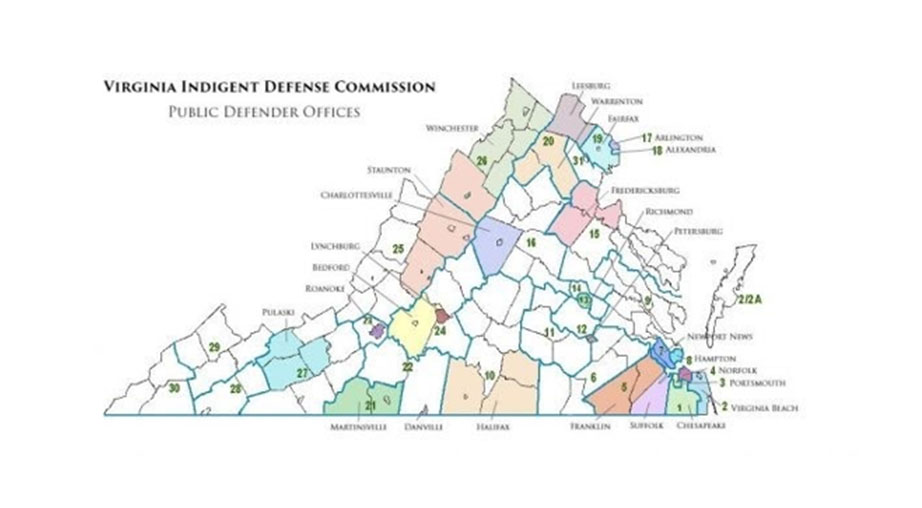
Not every jurisdiction in Virginia has a Public Defender’s Office. The Virginia Indigent Defense Commission has published the following map to show which jurisdiction is served by a Public Defender. 


jurisdictions map, public defenders in virginia


However, the map incorrectly identifies Harrisonburg and Rockingham County as a jurisdiction served by a Public Defender.  Harrisonburg and Rockingham County does not yet have a Public Defender’s Office, but efforts are underway to establish an office in this jurisdiction. Currently, there is a list of more than 15 private lawyers in Harrisonburg who accept way-below-market wages from the court to represent the poor in our community. If a defendant is found guilty, those minimal legal fees are assessed to the defendant as court costs.


REQUESTING A COURT-APPOINTED ATTORNEY IN VIRGINIA


If you believe you need to request a court-appointed attorney, the judge will at your first appearance ask you to complete an affidavit listing your income, your assets, and your liabilities.  

The General Assembly of Virginia has promulgated a table that the judge will consult to determine whether you qualify as “indigent” and, therefore, in need of a court-appointed attorney. 

It is very acceptable and happens on many occasions that a person initially obtains a court-appointed attorney but after meeting with him contacts Cook Attorneys or another private lawyer to inquire about retaining counsel for his case. 

If you are in this situation and choose to hire Cook Attorneys, we can contact your court-appointed attorney to let him know that we will be taking over the case and that he does not need to perform any additional work on the case. 

We will also contact the court to let the clerk and the judge know that we are now representing you and that further correspondence or notifications from the court should be sent to you through us at Cook Attorneys.  


LET US HOST YOU FOR A FREE CRIMINAL DEFENSE CONSULTATION


Whether you have requested a court-appointed attorney or not, our Harrisonburg VA criminal attorneys offer free initial consultations for most criminal defense clients. 

You can learn more about what to expect from our free criminal defense consultations. When you’re looking for the best criminal lawyers in Virginia, it is a good idea to ask around and to shop around prior to hiring an attorney.  

While self-representation is an option, it is often ill-advised because of the complexity of the legal system. It’s just not possible to duplicate the expertise that a criminal defense attorney can bring to your case.


Our team at Cook Attorneys in Harrisonburg hopes to have the opportunity to support you in ensuring the best possible outcome for your case. Please contact us to schedule an appointment today.


Fill out the form below to request more information about how we can serve you. Se habla español. We look forward to hearing from you!